The Scout Mindset: Is Better Reasoning a Skill, a Culture, or Both?
Test Julia Galef’s truth-seeking ideal against motivated reasoning, incentives, identity, power, debiasing transfer, and the institutional conditions for honest updating.
Better reasoning is both skill and culture. Individuals can practise calibration, consider rivals, separate identity from belief, and reward themselves for updating. But these habits weaken when organizations punish uncertainty, reward loyalty, conceal outcomes, or let status settle disputes. Build the person and the environment together. The scout metaphor does not diagnose individuals, eliminate value conflict, or guarantee transfer from exercises to high-pressure institutions.
Reconstructing the scout ideal
Galef contrasts two orientations. The soldier asks how to defend a side; the scout asks what the territory is actually like. The important claim is motivational: reasoning quality depends not only on computational intelligence but on whether a person can tolerate unwelcome reality and remain curious about error.
The metaphor avoids the fantasy of a permanently unbiased person. A scout can want an outcome and still seek an accurate map. The book’s practical ambition is to make truth-seeking emotionally compatible with dignity, belonging, and action.
Intellectual inheritance behind the Scout Mindset
The intellectual genealogy includes Bacon’s idols, Peircean inquiry, Popperian fallibilism, Bayesian updating, cognitive-bias research, and Tetlock’s forecasting work. The soldier–scout contrast also belongs to a longer ethical tradition in which intellectual humility and courage are virtues, not merely techniques.
This genealogy reveals tension. A virtue can guide conduct when no checklist fits, but virtue language can blame individuals for failures produced by institutions.
Counterevidence: awareness does not reliably transfer
Someone can explain motivated reasoning and still rationalize a preferred decision. The live situation may not resemble the classroom example; status and time pressure change behavior; outcomes arrive too late to teach; and the person may gain social reward from confidence.
This is why “be curious” is an incomplete intervention. Independent estimates, precommitted criteria, blind first review, forecast scoring, and meaningful dissent rights can make scout behavior easier to execute when identity is engaged.
The scout capability stack: the claim-bearing evidence
Galef synthesizes research, cases, and practical exercises around motivated reasoning and identity. Nickerson’s review documents confirmation bias across search, interpretation, and memory. Milkman and colleagues distinguish interventions that modify decision makers from those that modify the environment. Together they support a layered account rather than mindset alone.
galef-scout, nickerson-confirmation, milkman-decisionClaim sources: galef-scout, nickerson-confirmation, milkman-decision
A culture that performs scouting
Imagine a product team deciding whether an AI assistant improved customer support. A scout-capable culture does not ask everyone to suppress enthusiasm. It records the intended outcome, baseline, failure conditions, and adoption constraints before the pilot. Analysts estimate independently. Customer harm signals have an owner. The sponsor must state evidence that would stop expansion.
After results, people are praised for well-justified updates, including downward ones. The decision record distinguishes a bad outcome from a bad process. This turns the mindset into an organizational memory.
The adversarial reading
“Scout” can become a flattering identity. People who see themselves as rationalists may scrutinize outsiders while assuming their own community is unusually self-correcting. Politeness and probabilistic language can mask power: the person with authority still chooses which uncertainty is tolerable.
The counterargument is not that truth-seeking is impossible. It is that self- description provides almost no evidence. A scout claim needs a track record: visible forecasts, inconvenient corrections, serious rivals, and decisions changed before outcomes forced capitulation.
When scout language misfires
- Treating emotion as the enemy of reason.
- Calling opponents soldiers and allies scouts.
- Equating frequent uncertainty with calibration.
- Demanding curiosity from people who bear asymmetric harm.
- Using “updating” to excuse unstable principles.
- Substituting a debiasing workshop for incentive reform.
- Asking the same AI to supply the view and its critic.
- Ignoring decisions that cannot wait for full evidence.
Make belief revision observable
A team cannot infer scout behavior from self-description. Use a revision record: the original claim, confidence, strongest rival explanation, evidence requested in advance, new evidence, updated confidence, and decision consequence. The record should reward timely correction, not only being right on the first attempt.
This creates a sharper test than civility. A person can speak politely while moving no probability, and can disagree forcefully while responding precisely to evidence. Likewise, changing a view is not automatically virtuous; noisy signals and social pressure can produce performative flexibility. The quality lies in whether the update tracks diagnostic evidence.
Institutional design matters most when revision is expensive. Separate the person who generated a proposal from the person who runs the adversarial test. Let junior members surface disconfirming observations without career penalty. Record when senior forecasts fail. Scout mindset becomes credible when the system changes the payoff for seeing inconvenient terrain.
Build a scout-capable environment
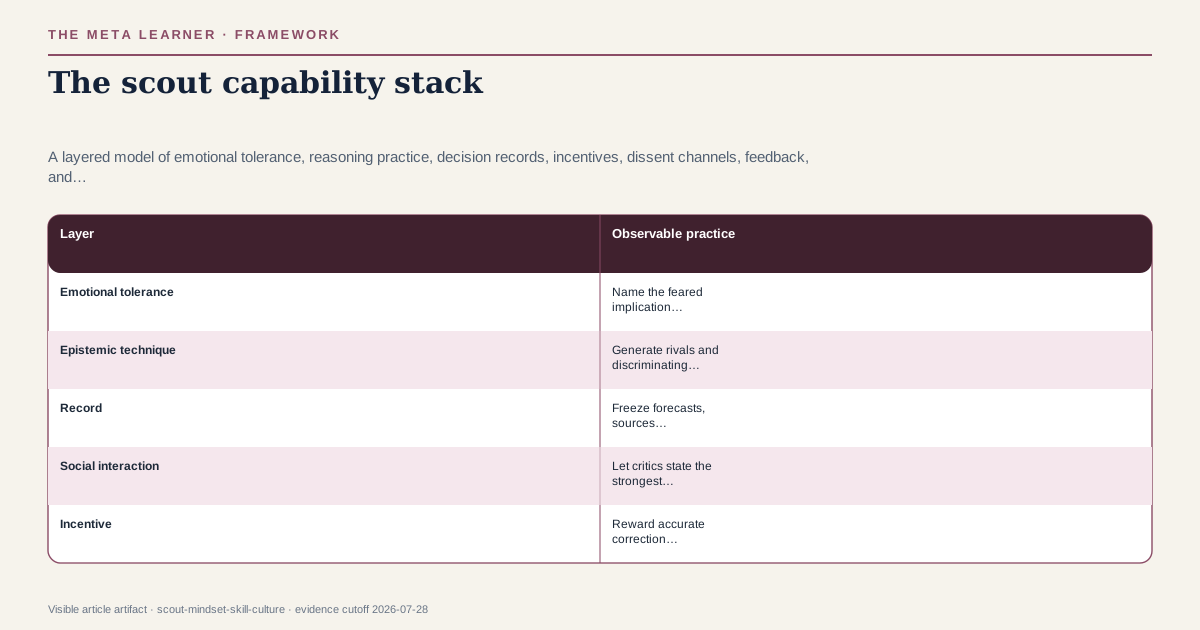
Build from the inside outward:
| Layer | Observable practice | |---|---| | Emotional tolerance | Name the feared implication of being wrong | | Epistemic technique | Generate rivals and discriminating evidence | | Record | Freeze forecasts, sources, and update thresholds | | Social interaction | Let critics state the strongest version of their case | | Incentive | Reward accurate correction, not unwavering confidence | | Institution | Protect dissent and preserve correction history |
Training one layer while the next punishes it creates fragile improvement.
Reversal conditions for the scout capability stack
Emphasize individual skill when the person controls the decision, feedback is fast, error is bounded, and incentives do not strongly favor one answer. Emphasize structural control when stakes are high, hierarchy shapes speech, outcomes are delayed, or many people inherit one error.
The scout ideal should yield when the question is not purely epistemic. Values, rights, and commitments cannot always be solved by a more accurate probability. Accuracy informs judgment; it does not select the moral objective.
The boundary of this reading of the Scout Mindset
The book is a practical synthesis, not a systematic estimate of intervention effects. Bias categories and debiasing transfer remain contested, and cultural or organizational power cannot be reduced to one mindset. Truth-seeking also operates within value commitments. High-stakes institutional designs need local evaluation and accountability.
See how research can deepen confirmation bias, turn awareness into decision controls, and scale the practice through a constitution of knowledge.
Named sources
Evidence and further reading
Published July 29, 2026. No substantive revision has been recorded. Evidence last verified July 28, 2026.