The Constitution of Knowledge: Can Institutions Outperform Individual Intelligence?
Test Jonathan Rauch’s institutional account of truth against reproducibility, exclusion, concentrated power, platform incentives, and AI-mediated disagreement.
Institutions can outperform individuals when no participant is final: claims must remain contestable, evidence traceable, criticism protected, methods inspectable, errors correctable, and relevant perspectives able to enter. An institution’s name does not confer truth. Its advantage comes from an error-correcting architecture that can expose even prestigious insiders to revision. Institutions can exclude relevant participants, preserve hierarchy, reward novelty or conformity, and fail to correct on a useful timescale.
Reconstructing the institutional thesis
Rauch’s central argument is that objective knowledge is not produced by isolated objectivity. It emerges from a social constitution: rules and norms that turn disagreement into tested public claims. No person has privileged access to reality; assertions acquire standing through an open-ended network of checking and correction.
This is stronger than “trust experts.” Experts themselves are products and participants of institutions. Their claims remain vulnerable to evidence, qualified criticism, and future correction. The institutional thesis explains why an ordinary individual need not personally replicate every experiment to know more reliably than personal experience allows.
Intellectual inheritance behind the Constitution of Knowledge
The intellectual genealogy includes Peirce’s community of inquiry, Popper’s fallibilism, Merton’s norms of science, Mill’s defense of open discussion, and modern social epistemology. Rauch combines these predecessors with a liberal political concern: knowledge systems need rules that prevent any claimant, faction, or authority from ending the conversation by status alone.
Longino adds a crucial pressure test. A community is not adequately critical because objections are technically permitted. It needs recognized venues, shared standards, uptake of criticism, and qualified equality of intellectual authority. Who can enter the room changes which assumptions become visible.
Counterevidence inside the system
Reproducibility and replication problems show that an institutional order can possess admirable norms while local incentives undermine them. Publication bias, career pressure, inaccessible data, flexible analysis, and weak correction can make formal review look more reliable than it is.
This counterevidence does not refute institutional knowledge; individuals are not immune to the same failures. It changes the burden. Authority should track the actual quality of methods, transparency, independent convergence, and correction—not institutional branding.
The hardest objection to The institutional error-correction audit
Institutions can become slow, exclusionary, self-protective, and detached from people who experience their errors. Decentralized outsiders sometimes detect failures that credentialed communities dismiss. Moreover, disagreement can be strategically manufactured: organized doubt may consume attention without improving truth.
The thesis survives only with a distinction between openness and limitless procedural equality. Claims earn weight through evidence and relevant competence, while entry routes and standards themselves remain available for criticism.
The institutional error-correction audit: the claim-bearing evidence
Rauch presents liberal science as a decentralized rule system for public knowledge. National Academies analysis distinguishes reproducibility from replicability and treats transparency, methods, data, incentives, and correction as system-level concerns. Longino’s social epistemology argues that criticism can make inquiry more objective when communities provide genuine avenues for challenge and uptake.
rauch-constitution, nasem-reproducibility, longino-social-knowledgeClaim sources: rauch-constitution, nasem-reproducibility, longino-social-knowledge
Audit a truth-seeking institution
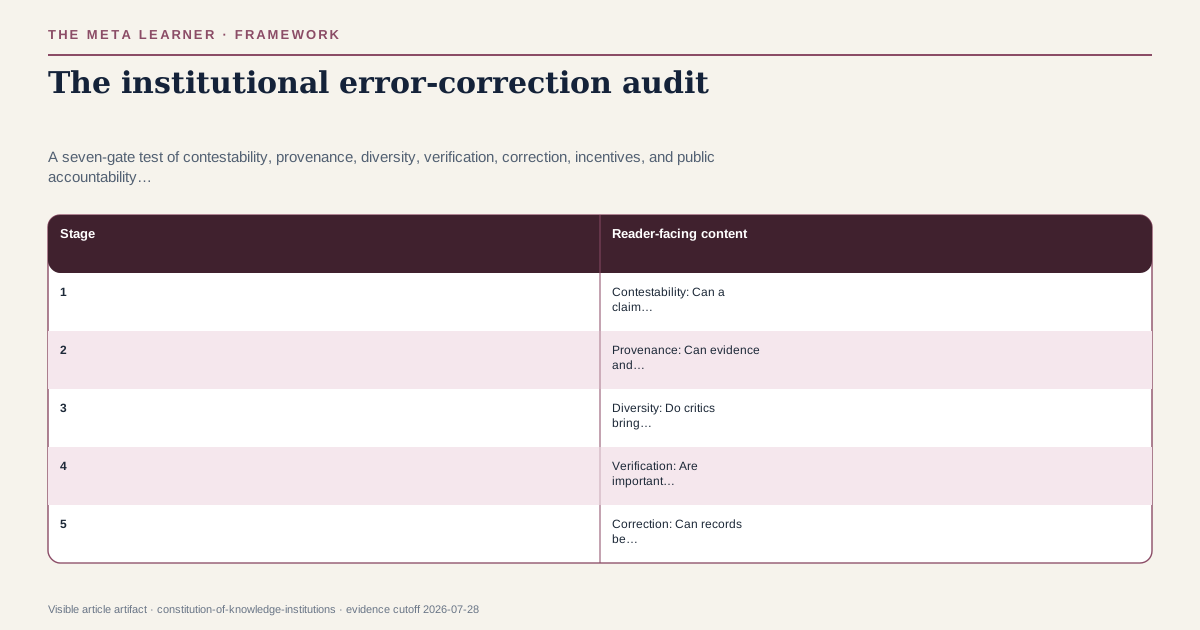
Evaluate an institution through seven gates:
- Contestability: Can a claim be challenged without retaliation?
- Provenance: Can evidence and transformations be traced?
- Diversity: Do critics bring different data, methods, and situated knowledge?
- Verification: Are important results checked independently?
- Correction: Can records be amended without erasing the history?
- Incentives: What receives status, funding, speed, and attention?
- Accountability: Who bears the cost when the system is wrong?
Passing one gate cannot compensate automatically for failing another. Open comment sections produce disagreement but not necessarily qualified criticism. Elite peer review supplies expertise but can preserve shared blind spots.
Build correction capacity, not only content rules
Content rules ask whether one item may remain. Correction capacity asks whether the system can discover error, preserve the challenge, update the record, and restore trust without depending on a benevolent insider.
For an AI-mediated knowledge service, inspect five capacities. Can a reader trace a claim to the underlying source? Can a qualified dissenter attach counterevidence? Does the institution distinguish a retraction, correction, clarification, and unresolved dispute? Can outsiders study aggregate error without exposing private data? Is a successful challenge reflected in later outputs?
These questions resist two fantasies. Perfect moderation is impossible because standards must be applied under uncertainty. Completely open circulation does not produce correction automatically because attention, harassment, money, and status shape which challenges survive.
A constitution of knowledge is therefore less like a static rulebook than an error-correcting architecture. Its quality appears not when every participant agrees, but when disagreement can become inspectable evidence and institutional learning.
A worked AI-mediated institution
A newsroom uses one language model to summarize sources, propose headlines, flag errors, and rank stories. Human editors remain, so the process appears institutional. Yet the same upstream system shapes discovery, framing, and review. Apparent disagreement may share a hidden source distribution.
The audit recommends independent source retrieval, a visible claim ledger, specialist checks for pivotal claims, separation of generation from evaluation, and a correction record. AI may widen search and reduce clerical cost. It should not silently occupy every error-correcting role.
Reversal conditions for the institutional error-correction audit
Confidence in an institution should rise when independent methods converge, negative findings remain visible, corrections are timely, critics can influence the record, and incentives penalize concealment. It should fall when one source chain dominates, dissent predicts retaliation, replication is structurally impossible, or public claims cannot be traced to evidence.
For urgent action, institutions may need provisional decisions. Fallibility does not require paralysis; it requires explicit confidence, reversible policy where possible, monitoring, and authority to correct.
Institutional shortcuts
- “Peer reviewed” used as a substitute for reading the design.
- “Consensus” reported without its scope or method.
- Outsiders treated as right merely because they are excluded.
- More debate confused with better criticism.
- Correction counted as proof that the institution never fails.
- A single AI system treated as an independent second opinion.
- Truth reduced to whichever network coordinates fastest.
The boundary of this reading of the Constitution of Knowledge
The constitutional metaphor highlights norms and procedures but can understate material power, unequal access, geopolitical variation, and slow correction. Reproducibility differs by field, and public decisions sometimes precede epistemic settlement. This analysis cannot adjudicate specific institutional claims without examining their actual evidence and governance.
Apply the architecture through the CLAIM audit, compare institutions with information networks, and protect correction from AI monoculture.
Named sources
Evidence and further reading
Published July 29, 2026. No substantive revision has been recorded. Evidence last verified July 28, 2026.