Nexus: Do Information Networks Produce Truth—or Merely Coordination?
Test Yuval Noah Harari’s history of information networks against information theory, institutional epistemology, propaganda, bureaucracy, power, and AI-generated scale.
Information networks do not inherently produce truth. They can transmit signals, coordinate action, preserve stories, administer populations, and concentrate power whether their representations are accurate or false. Truth production requires extra machinery: source provenance, discriminating evidence, independent criticism, correction, and institutions able to resist the network’s owners. One platform study and a mathematical communication theory cannot validate a macrohistory of all information networks.
The network argument
Harari’s book interprets history through information networks, from oral stories and religious texts to bureaucracy, mass media, totalitarian records, computers, and AI. Its central claim separates information from truth. Networks gain power because they connect and coordinate, not because every message accurately represents reality.
This distinction explains a paradox. A society can possess more information, faster communication, and stronger coordination while becoming less able to correct a foundational error. The network may reward loyalty, speed, or administrative consistency over correspondence with the world.
Intellectual inheritance behind Nexus
The intellectual genealogy includes Shannon’s information theory, cybernetics, McLuhan and media theory, studies of bureaucracy and propaganda, network science, and Harari’s earlier emphasis on shared stories. The book also touches a social-epistemic lineage: societies need institutions that subject claims to criticism rather than merely repeat them.
These predecessors use “information” differently. Bits, meaning, records, stories, evidence, and knowledge cannot be exchanged without argument.
Counterevidence to network determinism
Network structure matters, but institutions, content, culture, and actor strategy shape outcomes. The same printing technology supported scientific criticism, religious authority, propaganda, and dissent. A platform affordance does not determine one politics.
The online false-news study concerns one platform, period, classification process, and behavior. It supports a mechanism worth testing, not a law that falsehood always wins. Changes in ranking, community, media literacy, and institutional trust can alter diffusion.
The hardest objection to The truth-coordination audit
Large networks sometimes aggregate dispersed knowledge better than any central authority. Markets, prediction systems, open-source projects, and scientific communities can outperform individual planners.
The relevant question is which aggregation mechanism, incentives, entry rules, and feedback connect local information to correction. “The network knows” is as empty as “the state knows” without this architecture.
truth-coordination audit: the claim-bearing evidence
Harari offers a broad historical synthesis of information, mythology, bureaucracy, democracy, and AI. Shannon’s communication theory deliberately abstracts from semantic meaning to model transmission. Research on Twitter diffusion found that false news spread farther, faster, deeper, and more broadly than true news in the studied data, with human sharing playing an important role.
harari-nexus, shannon-information, vosoughi-newsClaim sources: harari-nexus, shannon-information, vosoughi-news
A bureaucratic case
A national education dashboard standardizes attendance, test scores, and completion. It enables resource coordination across thousands of schools. The same categories narrow what officials can see: informal learning, disability barriers, gaming, local language, and outcomes not captured by tests.
If funding follows the dashboard, representation becomes intervention. Schools adapt to the measure. The audit adds qualitative sampling, correction rights, multiple measures, and limits on using one score for punitive decisions. Coordination is preserved without pretending the network is a transparent mirror.
AI as an agent in the network
Harari emphasizes that AI can generate, select, and interact with information rather than merely transmit human messages. That creates scale and feedback: systems can personalize persuasion, generate synthetic participants, and alter the data used by later systems.
But “AI decided” can hide a chain of designers, objectives, data, deployers, and users. Machine agency does not dissolve institutional responsibility. Map which component produced what action and who can stop or remedy it.
Truth institutions are costly
Verification slows transmission. Replication consumes resources. Corrections receive less attention than original claims. Independent journalism, science, courts, archives, and audit require autonomy and funding.
This explains why a truth-seeking network may lose a speed contest. Its advantage is not maximum virality but error correction over time. Governance must protect the slower functions without allowing them to become unaccountable monopolies.
Run the truth-coordination audit
For a network, inspect:
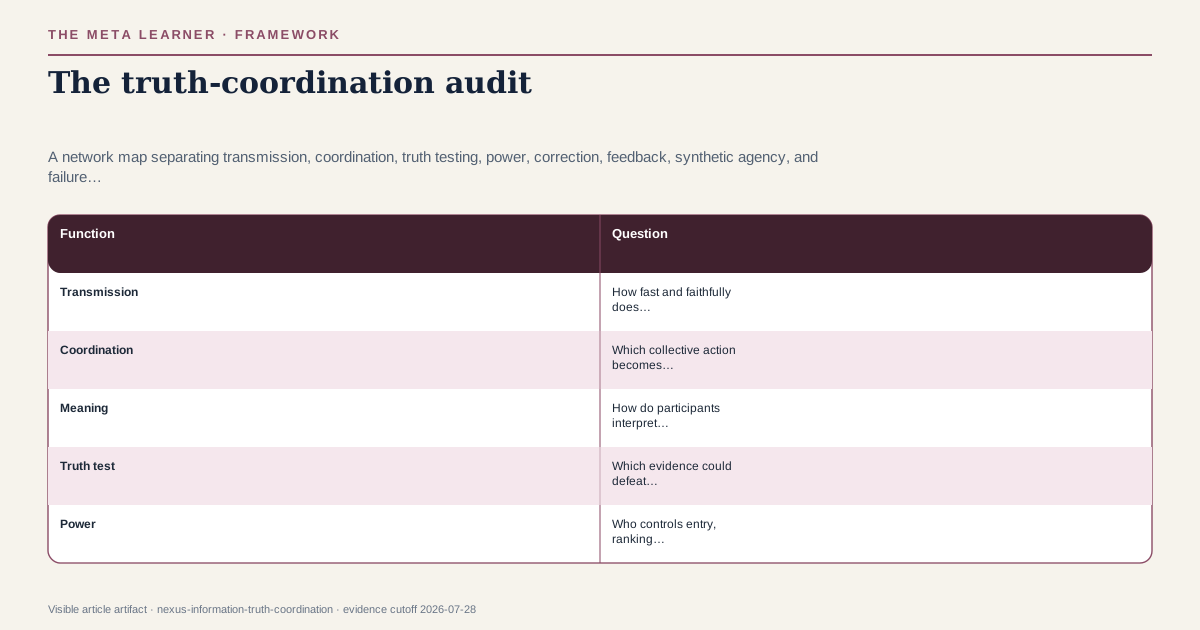
| Function | Question | |---|---| | Transmission | How fast and faithfully does a signal move? | | Coordination | Which collective action becomes possible? | | Meaning | How do participants interpret the signal? | | Truth test | Which evidence could defeat the representation? | | Power | Who controls entry, ranking, visibility, and identity? | | Correction | Can errors propagate backward into the record? | | Adaptation | How do actors game or respond to the network? | | Containment | What limits correlated failure? |
A network can score high on transmission and coordination while failing the truth and correction columns.
Budget for truth production
Truth-maintaining institutions consume scarce resources: expert attention, records, replication, local reporting, adversarial review, correction, and public trust. A network that multiplies claims without expanding these capacities creates an epistemic deficit even when transmission becomes nearly free.
Build a truth-capacity budget for one domain. Count how many consequential claims enter the system, which can be checked automatically, which require original-source access, which demand specialist judgment, how long correction takes, and whether the correction reaches the audience that saw the error. Then identify who pays for the work and who benefits from rapid circulation.
AI can reduce some costs—translation, comparison, anomaly detection, or retrieval—while raising claim volume and enabling synthetic coordination. The net effect is an empirical institutional question. The key ratio is not information per person; it is consequential claims relative to credible verification and correction capacity. A healthy network protects that capacity before abundance consumes it.
Reversal conditions for the truth-coordination audit
Trust network outputs more when independent sources converge, provenance survives transformation, incentives penalize deception, corrections alter future distribution, and power is contestable. Trust them less when attention is the dominant objective, synthetic activity is invisible, one platform controls generation and evaluation, or errors become socially costly to retract.
For bounded coordination, truth may not be the primary objective: a calendar network need only align participants. The boundary changes when the representation justifies consequential belief or action.
Network-level confusions
- Equating information quantity with knowledge.
- Applying Shannon’s measure as a semantic theory.
- Treating virality as truth or falsity.
- Blaming “the algorithm” without institutional actors.
- Assuming decentralization eliminates concentrated power.
- Treating all coordination as legitimate.
- Counting AI accounts as independent participants.
- Demanding truth institutions move at propaganda speed.
The boundary of this reading of Nexus
The book’s macrohistory compresses diverse periods, institutions, and technologies. The empirical diffusion evidence cannot validate every historical bridge, and AI capabilities change. System-specific claims need current primary evidence and final verification at the authorized publication cutoff.
Compare network flow with a constitution of knowledge, protect diversity against AI monoculture, and ask who governs the network in The Technological Republic.
Named sources
Evidence and further reading
Published July 29, 2026. No substantive revision has been recorded. Evidence last verified July 28, 2026.