The Knowing-Doing Gap: Why Insight Rarely Changes Practice
Test Pfeffer and Sutton’s organizational diagnosis against capability gaps, implementation science, incentives, psychological safety, feedback, and local uncertainty.
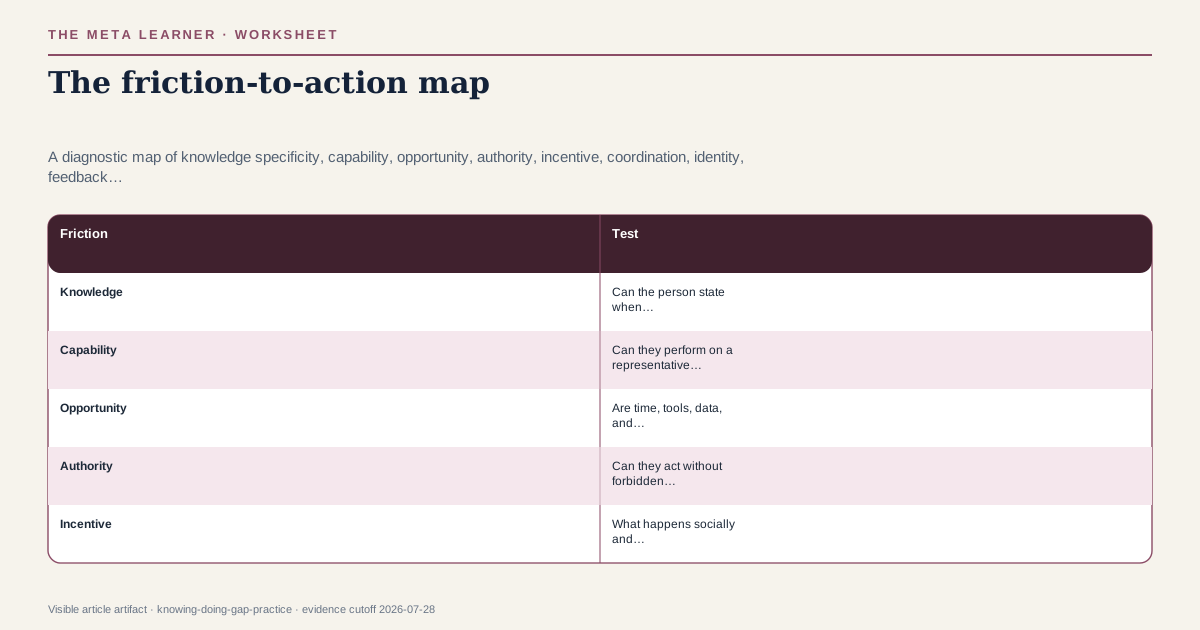
Diagnose the gap before pushing harder. Ask whether people know the exact action, can perform it, have time and tools, possess authority, expect consequences consistent with the request, can coordinate with others, and receive valid feedback. Change the binding condition, run the behavior in a real workflow, and measure use and outcome separately.
The argument against organizational talk
Pfeffer and Sutton argue that organizations often possess substantial knowledge about effective practice but substitute discussion, planning, imitation, fear, and internal competition for action. Knowledge becomes status: leaders say the right things, commission training, and collect best practices while the daily system rewards old behavior.
The central claim is not anti-knowledge. Knowing grows through doing, feedback, and teaching. The target is a management culture in which eloquent abstraction is mistaken for implementation.
Intellectual inheritance behind the Knowing-Doing Gap
The intellectual genealogy includes pragmatism, Lewin’s action research, organizational learning, quality improvement, behavior design, and later implementation science. It also echoes Aristotle’s distinction between propositional knowledge and practical wisdom.
This lineage matters because “doing” is not the mechanical downstream of “knowing.” Practice generates knowledge about context, feasibility, and coordination that reflection alone cannot supply.
Counterevidence: sometimes we do not know
“We already know what works” can be managerial overconfidence. Evidence from another organization may not transfer; the mechanism may be unclear; staff may lack tacit skill; or the desired practice may not improve the actual outcome.
Implementation before local causal understanding can scale harm. The knowing–doing frame should not shame skepticism or erase disagreement. Add a knowledge test: what evidence supports the practice, for which population, and what result would stop it?
The power problem
Leaders often locate the gap in employees while controlling targets, workload, information, and sanction. Asking “why don’t they execute?” can conceal a rational refusal, conflicting objectives, or risk displaced downward.
Include affected workers in diagnosis. Preserve dissent that challenges the practice itself. A knowing–doing intervention should not become a compliance machine for an untested leadership belief.
friction-to-action map: the claim-bearing evidence
The book synthesizes organizational cases and diagnoses barriers such as talk, memory, fear, measurement, and competition. The Consolidated Framework for Implementation Research organizes determinants across intervention, setting, individual, and process. Implementation-intention experiments show that specific cue-linked plans can improve goal enactment in some contexts. No single level explains every gap.
pfeffer-sutton-gap, damschroder-cfir, gollwitzer-intentionsClaim sources: pfeffer-sutton-gap, damschroder-cfir, gollwitzer-intentions
When plans help and when they do not
Cue-linked plans are useful when motivation exists and a specific behavior fails at the moment of action. “When I open the weekly report, I will first check the denominator” is executable.
Plans fail when the cue is unpredictable, authority is missing, the action requires collective coordination, or incentives punish it. An implementation intention cannot create a budget, resolve role conflict, or make unsafe work safe.
Build the friction-to-action map
For one target behavior, diagnose:
| Friction | Test | |---|---| | Knowledge | Can the person state when and how to act? | | Capability | Can they perform on a representative task? | | Opportunity | Are time, tools, data, and access present? | | Authority | Can they act without forbidden escalation? | | Incentive | What happens socially and materially if they comply? | | Coordination | Which other roles must change simultaneously? | | Identity | Does the behavior threaten competence or belonging? | | Feedback | Can the person see outcome and error? |
Choose evidence that distinguishes the top two frictions. Another training course tests very little when staff already know the procedure.
Measure enacted knowledge
An organization knows something operationally only when the relevant behavior appears under real constraints. Replace attendance and document counts with a small set of enactment traces: whether the new action occurred, at which decision point, with what delay, under whose authority, and what happened when it conflicted with an existing target.
Suppose a team learns that source provenance should precede publication. Knowledge is not demonstrated by completing a workshop. It appears when an unsupported claim is stopped despite deadline pressure, the source field is available in the workflow, an editor can require correction, and management does not punish the delay.
Negative cases are essential. Record the first five occasions when the desired practice did not occur and identify whether the cause was missing skill, missing access, competing incentives, ambiguous ownership, or deliberate disagreement. The knowing–doing gap becomes actionable only after “we know” is decomposed into evidence about who can do what in the system.
A worked knowledge program
A company tells managers to give frequent developmental feedback. Survey responses show managers understand the principle. Actual feedback remains rare.
The map finds that calendars are overloaded, performance disputes are risky, promotion rewards delivery rather than people development, and the software turns every note into a permanent record. The gap is not ignorance.
The organization protects a short coaching format, separates developmental notes from formal evaluation, trains on real conversations, and samples quality rather than counting completed forms. Managers use an implementation intention: after a project milestone, ask one evidence-based question and agree on the next attempt. Adoption and employee outcome are measured separately.
Reversal conditions for the friction-to-action map
Use training when representative performance reveals missing skill. Change environment when people perform correctly in simulation but not at work. Change incentives when the requested action conflicts with promotion or measurement. Redesign the practice when local outcomes fail despite faithful use.
Stop adding interventions when the activity becomes ritual, workload crowds out the target benefit, or adoption metrics rise while outcomes do not. Sometimes the correct action is to remove a procedure.
Implementation theatre
- Training people on a constraint they cannot change.
- Counting plans, meetings, or form completion as practice.
- Copying a prestigious company without mechanism evidence.
- Calling rational resistance a mindset problem.
- Setting a goal with no cue, owner, or resource.
- Measuring adoption but not capability or outcome.
- Letting AI produce procedures nobody has tested in the workflow.
- Rewarding talk about learning more than error disclosure.
The boundary of this reading of the Knowing-Doing Gap
The book’s cases do not estimate universal causal effects, and implementation frameworks can become long determinant lists. Local diagnosis requires direct workflow evidence. Some practices are constrained by law, labor agreements, safety, or professional judgment beyond managerial control.
Turn bias awareness into process control, learn through real projects, and check whether execution pressure reproduces burnout.
Named sources
Evidence and further reading
Published July 29, 2026. No substantive revision has been recorded. Evidence last verified July 28, 2026.