The Burnout Society in the AI Era: Does Acceleration Produce Freedom or Exhaustion?
Test Byung-Chul Han’s self-exploitation thesis against occupational burnout evidence, AI acceleration, job resources, autonomy, and work design.
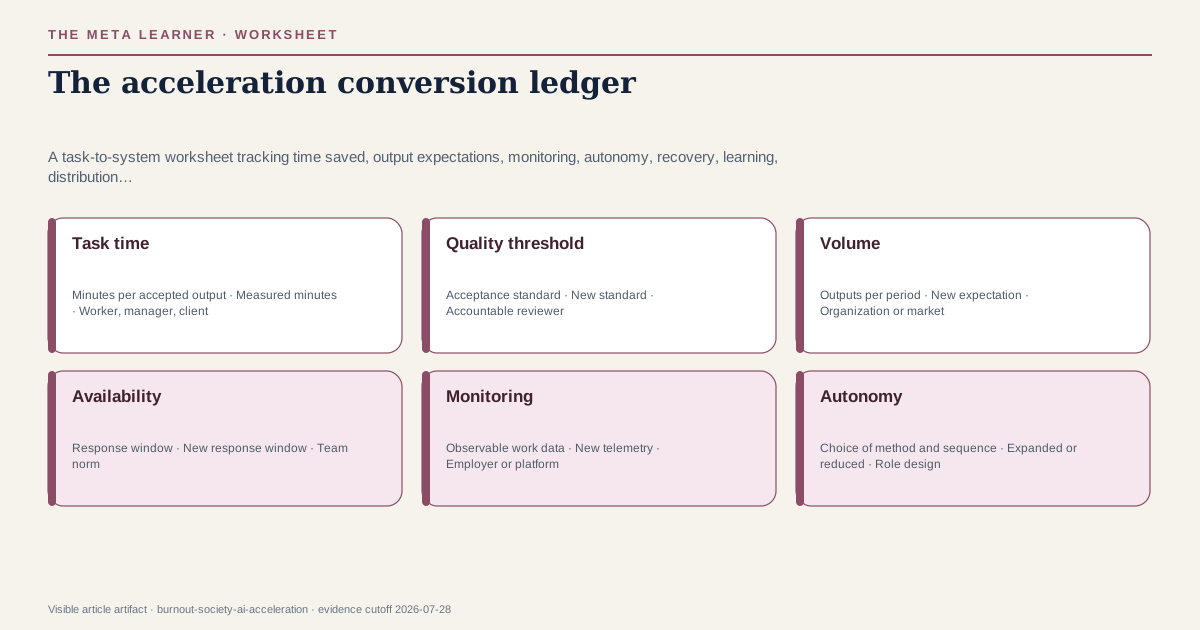
AI acceleration produces freedom only when reduced task cost becomes greater autonomy, recovery, learning, or meaningful capacity. It produces exhaustion when the same gain becomes more volume, shorter deadlines, constant availability, tighter monitoring, or pressure to optimize oneself. Measure the conversion of saved time, not the speed of the tool alone.
Intellectual inheritance behind the Burnout Society
The intellectual genealogy includes Marx on alienation and the organization of labor, Weber on discipline and rationalization, the Frankfurt School’s critique of administered life, and Foucault on disciplinary power and the production of self-governing subjects. Han’s “achievement subject” shifts emphasis from an external factory supervisor to internalized optimization.
A parallel empirical lineage runs through occupational stress, demand–control models, effort–reward imbalance, emotional exhaustion, and the job demands–resources framework. That work asks questions Han’s sweeping style usually does not: which demands, which resources, which people, under which conditions, measured how?
The two lineages are useful together but should remain distinct. Philosophy can make a social pattern thinkable. Occupational evidence can test bounded mechanisms and interventions.
Reconstructing the acceleration thesis
Byung-Chul Han’s compact philosophical argument describes a change in the felt structure of power. The contemporary subject does not merely obey an external command; the subject becomes a project, continually improving, displaying, and exploiting the self. The language of possibility—“you can”—can extract more than a visible prohibition because failure is experienced as personal inadequacy.
The central argument is social diagnosis, not a controlled occupational-health study. Han connects excess positivity, achievement, attention fragmentation, depression, and burnout into a portrait of an age. The force of the book lies in naming how freedom and coercion can become entangled.
AI intensifies the question. When a worker can draft, analyze, code, translate, or coordinate faster, the immediate experience may be empowering. But the organization decides what follows: fewer hours, deeper work, broader responsibility, more output, fewer workers, closer measurement, or an ever-rising baseline.
The acceleration conversion ledger: evidence, not verdict
Han offers a philosophical account of achievement and self-exploitation. The World Health Organization classifies burn-out as an occupational phenomenon, not a medical condition, and defines it in relation to chronic workplace stress that has not been successfully managed. Job demands–resources research supplies a more differentiated model: demands can contribute to strain, while resources support motivation and buffer costs. These sources do not prove a general causal effect of AI on burnout.
han-burnout, who-burnout, jd-r-modelClaim sources: han-burnout, who-burnout, jd-r-model
Counterevidence to a total diagnosis
Han’s rhetoric can make exhaustion sound like the universal destiny of modern life. It is not. Workers differ in occupation, security, health, autonomy, care obligations, bargaining power, and relationship to technology. Some tools remove painful demands. Some people gain access, creative range, or control that was previously unavailable.
The job demands–resources model is important counterevidence because it does not treat all intensity as identical. Challenging work can be meaningful when resources such as autonomy, support, feedback, competence, and recovery are present. Resources do not magically neutralize unlimited demand, but they explain variation hidden by a civilizational diagnosis.
The strongest counterargument also targets agency. Self-direction is not always disguised domination. Ambition, craft, and voluntary effort can be sources of identity and flourishing. The problem is not achievement itself; it is a system in which refusal becomes impossible and every capacity becomes a new minimum.
A worked editorial case
An editor uses AI to prepare an initial comparison of source documents. A bounded task falls from two hours to forty minutes. The tool creates a genuine capability: the editor can inspect more alternatives before drafting.
Under one design, the team preserves the deadline, spends part of the saved time opening original sources, and gives the editor discretion over use. Error review becomes more visible. Capacity is converted into quality, learning, and some recovery.
Under another design, the target triples. Drafting, correspondence, and revision remain unchanged; dashboards expose output counts; clients expect instant response; and the editor reviews synthetic material late at night. Each comparison is faster while the whole job becomes more demanding.
The same model capability supports both arrangements. The causal unit is the workflow plus its institutions.
The automation dividend
Every productivity gain creates a distribution question. The dividend can appear as lower prices, higher profit, better service, more output, shorter hours, higher pay, stronger quality, or slack for adaptation. Usually it is split, and the split reflects power rather than technology alone.
Make the choice explicit before deployment. If no one protects recovery or learning, those uses compete poorly against measurable volume. If workers bear verification cost but dashboards count only generated output, the measurement system structurally favors overload.
This suggests an institutional control: pair every automation metric with a capacity metric. Track rework, after-hours activity, interruption, reviewer load, discretion, error consequence, and learning time alongside throughput.
When acceleration should be refused
Reject or redesign an AI acceleration when safe verification takes longer than the apparent saving; sensitive monitoring is disproportionate; the system shifts unacknowledged risk to workers or the public; performance expectations rise before evidence; or the worker cannot meaningfully contest the new measurement.
The recommendation reverses when the tool removes a genuine demand, the workflow preserves standards and autonomy, gains are shared, and longitudinal evidence shows improved capacity rather than deferred exhaustion.
Use the acceleration conversion ledger
For one AI-assisted workflow, record the pre- and post-change system:
| Field | Before | After | Who decides? | |---|---|---|---| | Task time | Minutes per accepted output | Measured minutes | Worker, manager, client | | Quality threshold | Acceptance standard | New standard | Accountable reviewer | | Volume | Outputs per period | New expectation | Organization or market | | Availability | Response window | New response window | Team norm | | Monitoring | Observable work data | New telemetry | Employer or platform | | Autonomy | Choice of method and sequence | Expanded or reduced | Role design | | Recovery | Unallocated time and breaks | Protected or captured | Policy and power | | Learning | Time for feedback and skill | Preserved or displaced | Manager and worker | | Distribution | Who receives the gain? | Time, pay, profit, service | Bargaining and governance |
The decisive metric is not “hours saved.” It is what those hours become.
Burnout category errors
- Treating a philosophical diagnosis as an individual clinical assessment.
- Inferring lower workload from faster completion of one task.
- Counting output while ignoring pace, availability, and review burden.
- Calling surveillance “support” because it uses performance data.
- Offering resilience training while leaving chronic demands unchanged.
- Assuming every worker experiences the same tool as liberation or threat.
- Treating fatigue as personal failure instead of investigating work design.
The boundary of this reading of the Burnout Society
This article relates a philosophical text to occupational-health and work-design evidence; it does not diagnose burnout or establish that AI causes it. The direct long-term evidence remains incomplete, and occupational effects depend on role, health, power, workflow, and institution. Individual distress warrants appropriate professional support, while organizational decisions require worker participation and current legal, safety, and technical evidence.
Protect concentration through the attention-residue boundary, restore agency through motivation and progress, and confront implementation through The Knowing–Doing Gap.
Named sources
Evidence and further reading
Published July 29, 2026. No substantive revision has been recorded. Evidence last verified July 28, 2026.