The Beginning of Infinity: Are Better Explanations the Engine of Progress?
Test David Deutsch’s optimism about explanatory knowledge against social institutions, measurement, tacit skill, power, implementation, and irreversible harm.
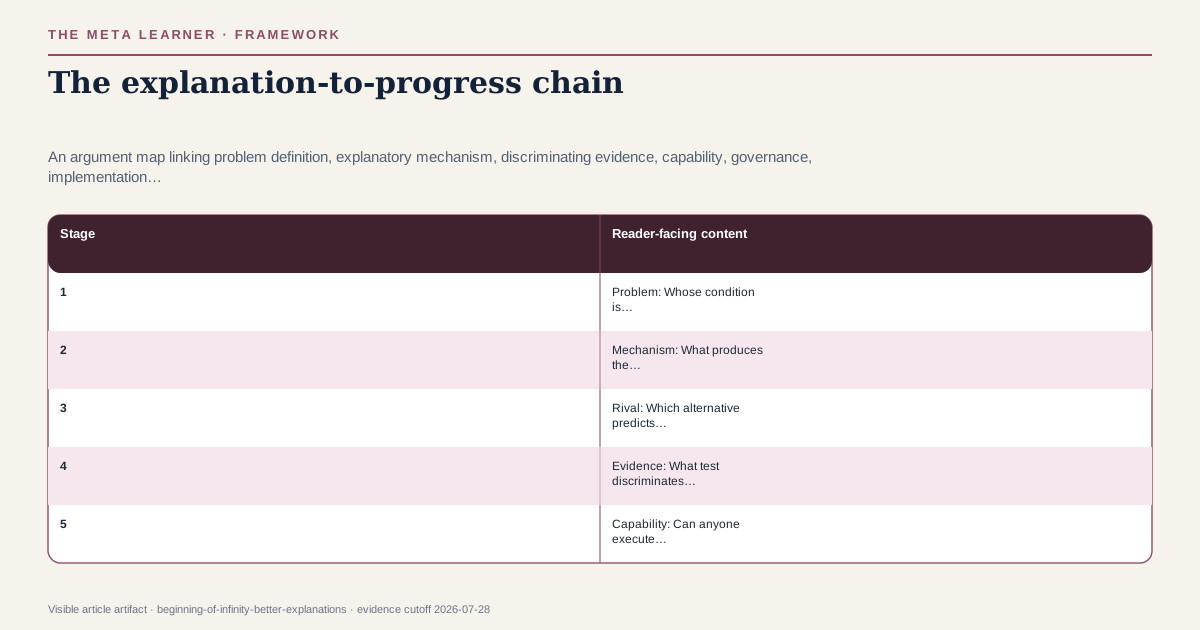
Better explanations are indispensable when they identify mechanisms, survive serious rivals, and guide successful intervention. They are not sufficient for progress. A society must notice the problem, permit criticism, build capability, coordinate action, distribute costs legitimately, and correct failure. An elegant explanation without these links can remain inert or become dangerous.
Reconstructing Deutsch's optimism
Deutsch argues that problems are soluble through the creation of explanatory knowledge and that progress need not approach a fixed ceiling. Humans are not confined to extrapolating from experience; they can conjecture explanations that reveal previously invisible possibilities.
His criterion of a good explanation is resistance to arbitrary variation. A story whose details can be changed freely while “explaining” the same outcome has little content. A better explanation connects parts so that alteration breaks the account or changes its predictions.
Intellectual inheritance behind the Beginning of Infinity
The intellectual genealogy runs through the Enlightenment, Popper’s conjectures and refutations, Turing’s universal computation, and Deutsch’s own work in quantum theory. It opposes inductivist pictures in which knowledge is simply read from accumulated observations.
There is also a rival lineage: Kuhn on paradigms, Polanyi on tacit knowledge, Longino on social criticism, and pragmatist attention to action. These predecessors ask who can formulate a problem, which background assumptions organize evidence, and how knowing becomes doing.
Counterevidence: explanation can be inert
Organizations often know that a process is unsafe yet fail to act because costs are shifted, authority is fragmented, or incentives reward delay. Public-health knowledge can exist without delivery capacity. A correct climate model does not select a politically legitimate transition.
These are not minor “implementation details.” They are causal parts of human progress. If a theory excludes them, it explains scientific discovery more successfully than social transformation.
The counterargument to the counterargument
Without explanatory knowledge, action becomes trial and error with poor transfer. Implementation sciences themselves seek better explanations of why interventions fail. Institutional reform requires models of incentives, power, and coordination. Deutsch’s thesis can therefore expand: the obstacles to implementation are more problems for explanation.
The expansion becomes circular if every failure is met only with “we need a better explanation.” Progress also needs resources, permission, practice, and time. A thesis must say which observation would show that explanatory quality was not the binding constraint.
The explanation-to-progress chain: the claim-bearing evidence
Deutsch develops a broad Popperian account of fallible explanatory progress. Platt’s strong-inference proposal emphasizes alternative hypotheses and experiments capable of excluding them. Longino shows that criticism is socially organized: background assumptions become visible through interaction among people with different perspectives. Explanation is both conceptual and institutional.
deutsch-infinity, platt-inference, longino-social-knowledgeClaim sources: deutsch-infinity, platt-inference, longino-social-knowledge
Explanatory overreach
- Treating a coherent story as hard to vary.
- Ignoring measurement that defines the problem.
- Assuming criticism is equally available to everyone.
- Calling implementation a secondary detail.
- Confusing technical possibility with legitimate progress.
- Saving a theory from every result with another explanation.
- Treating optimism as a forecast.
- Equating more information with better explanation.
Test an explanation as an intervention
Do not leap from theory to optimism. Audit each link:
- Problem: Whose condition is represented as needing change?
- Mechanism: What produces the outcome?
- Rival: Which alternative predicts a different observation?
- Evidence: What test discriminates rather than merely illustrates?
- Capability: Can anyone execute the implied intervention?
- Governance: Who authorizes risk and owns correction?
- Implementation: Do institutions and incentives transmit the solution?
- Outcome: Did capability, freedom, or welfare improve for affected people?
A break in the chain does not necessarily refute the explanation. It does refute the claim that explanation alone produced progress.
Use a problem-situation record
Before accepting an explanation, write the problem it was built to solve. Name the observations that resisted the prior account, the new mechanism, what the new account forbids, and which test could expose its failure. Then record the next problem created by the explanation rather than presenting understanding as finished.
This discipline distinguishes explanation from compression. A short formula can predict without making its mechanism intelligible; a long narrative can feel causal while accommodating every outcome. A good explanation earns its place by resolving a specific tension without arbitrary adjustment and by creating new, risky questions.
For AI-generated reasoning, preserve the source trail and reproduce any calculation independently. Fluent synthesis is a candidate contribution, not the end of criticism. Deutsch’s optimism becomes most defensible at this granularity: not “progress will happen,” but “this problem remains open to error-correcting inquiry under stated conditions.”
A worked AI claim
A company says larger models will solve hallucinated citations. The explanation is weak if “scale” can account for improvement, stagnation, or regression after the fact. A harder-to-vary account identifies training objectives, retrieval, verification, and task conditions, then predicts where each intervention should change error.
The team builds an evaluation with primary-source questions, unseen cases, and claim-level scoring. It also assigns human accountability. Even if one mechanism reduces citation error, deployment requires a recovery path and cost analysis. The explanation guides progress only through the complete chain.
Reversal conditions for the explanation-to-progress chain
Give explanation more causal weight when a new model predicts surprising observations, enables previously impossible intervention, transfers across cases, and displaces rivals. Give institutions or capability more weight when the mechanism is already well established but action fails along authority, resource, incentive, or legitimacy.
For irreversible high-stakes action, explanatory elegance cannot substitute for uncertainty bounds and safeguards. “All evils are caused by insufficient knowledge” is an ethical orientation, not a measured law.
The boundary of this reading of the Beginning of Infinity
Deutsch’s argument spans physics, epistemology, politics, aesthetics, and morality; no short analysis can test every bridge. Strong inference is itself more applicable to some sciences than others, and social criticism does not guarantee correction. The progress chain is an editorial synthesis, not a validated causal scale.
Write mind-change conditions, audit the model’s deformation, and examine the institutions of criticism.
Named sources
Evidence and further reading
Published July 29, 2026. No substantive revision has been recorded. Evidence last verified July 28, 2026.