How to Price Knowledge Work When AI Lowers Production Costs
Price knowledge work from buyer value, risk, evidence, access, scope, and accountability while using AI efficiency to redesign—not disguise—the offer.
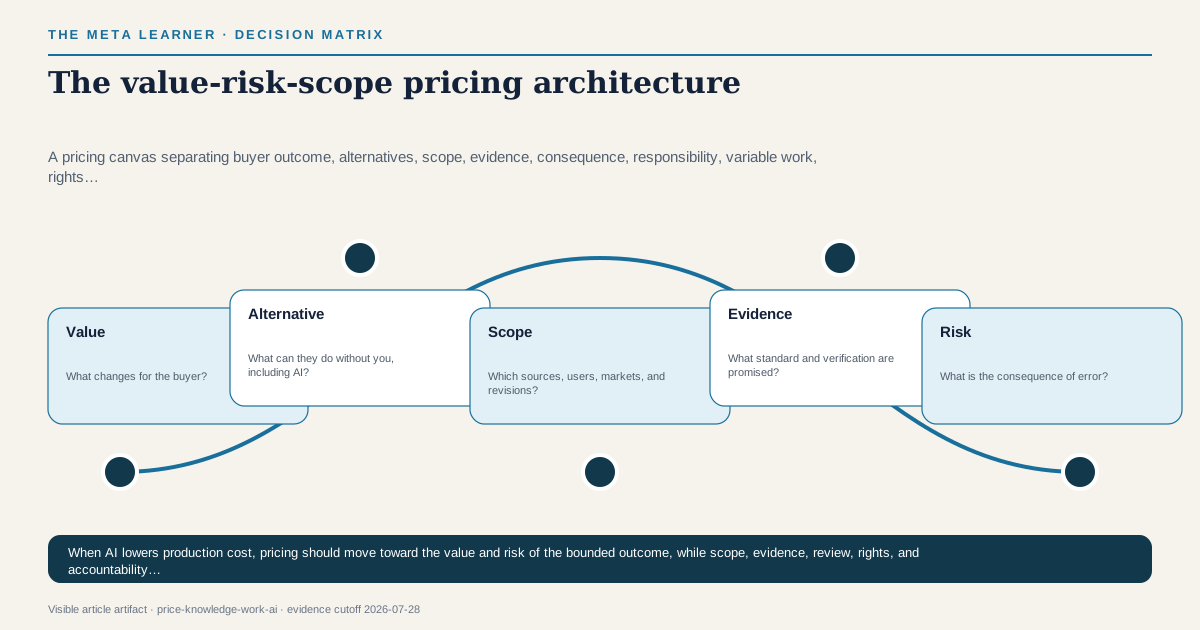
When AI lowers production cost, do not price by hidden effort alone. Define the buyer’s outcome, alternatives, scope, evidence standard, consequence of error, revision and escalation burden, rights, and responsibility. Choose a transparent model—project, retainer, usage, day rate, or value-linked where lawful and appropriate—then test it against real buyer behavior and your full delivery cost.
Time and value are separating
If a report takes three days instead of ten, an hourly quote falls unless the rate changes. Yet the client may care about the decision, not the keystrokes. At the same time, a faster tool can make alternative suppliers cheaper and reduce willingness to pay.
Both effects are real. “Never charge by time” and “pass every efficiency gain to the client” are slogans, not pricing analysis.
Map the economic object
What is the buyer purchasing?
- production capacity;
- access to specialized context;
- verified evidence;
- reduced decision uncertainty;
- coordination;
- implementation;
- transferred capability;
- accountability and correction;
- licensed rights.
Name the outcome and what is not included. A “research report” is an artifact. “A go/no-go market decision supported by verified bilingual sources and a downside scenario” is a bounded outcome.
The value-risk-scope architecture
| Layer | Question | |---|---| | Value | What changes for the buyer? | | Alternative | What can they do without you, including AI? | | Scope | Which sources, users, markets, and revisions? | | Evidence | What standard and verification are promised? | | Risk | What is the consequence of error? | | Responsibility | What do you own and what remains theirs? | | Variability | Which unknowns change effort? | | Rights | What may be reused, published, or licensed? | | Model | Which pricing unit aligns incentives? |
Do not set price until the layers are explicit.
SBA guidance supports examining demand, saturation, alternatives, barriers, and pricing. Field and policy research shows AI can change productivity and skill demand in particular contexts. These sources do not prescribe a price or prove that value pricing outperforms other models.
Claim sources: sba-market, nber-genai-work, oecd-ai-skills
Measure full delivery cost
Include:
- discovery and sales;
- source or data access;
- AI tools and infrastructure;
- human production;
- verification and correction;
- specialist review;
- project coordination;
- insurance, tax, and overhead;
- uncompensated revisions;
- risk reserve;
- post-delivery support.
The NBER field study on customer support found productivity changes in that setting, with heterogeneous effects.nber-genai-work, sba-market, oecd-ai-skills Do not assume the same time gain for your work, or ignore the evaluation needed to make output client-ready.
Choose a model deliberately
- Hourly or day rate: useful when scope is uncertain and client controls activity.
- Fixed project: useful when deliverables, exclusions, and acceptance are clear.
- Retainer: useful for continuing access, monitoring, or response capacity.
- Usage or unit: useful for standardized, measurable output with quality controls.
- Value-linked: possible when outcome value, attribution, measurement, and risk sharing are credible and lawful.
Hybrid models can separate discovery, delivery, and continuing assurance.
Be transparent without exposing operations
Tell the client:
- what standard they receive;
- how material claims are verified;
- whether AI use requires disclosure;
- which data may enter tools;
- who reviews;
- what rights transfer;
- what corrections and revisions include.
You do not need to itemize every internal minute. You must not misrepresent authorship, capability, confidentiality, or promised review.
Decomposing a case with the value-risk-scope pricing architecture
An independent analyst used to charge by the day for a market brief. AI reduces table formatting and first-pass classification.
The redesigned offer has:
- paid discovery;
- fixed fee for a defined decision brief;
- source count and geography boundaries;
- claim-level verification;
- one executive workshop;
- separate fee for interviews or legal review;
- explicit update exclusion.
The analyst tests the offer with three qualified buyers. One values speed, one values source access, and one declines because an internal team can use AI. The result is market evidence, not a universal pricing formula.
Test buyer alternatives
SBA market-research guidance asks about demand, market size, saturation, competitors, barriers, and what customers pay for alternatives.sba-market Interview buyers about recent behavior:
- What did they use last time?
- What failed?
- Who approved spending?
- Which risk justified external help?
- What would make the work unnecessary?
Do not ask only, “Would you pay?”
Build the value-risk-scope architecture
- Select one offer.
- name the buyer decision and alternative.
- define scope and acceptance.
- audit AI and human cost end to end.
- assign risk and responsibility.
- choose two pricing models.
- test with qualified buyers.
- revise from paid behavior and delivery margin.
Use Audit Your Work for Automation, Augmentation, and Human Judgment for costs, show proof through Build a Skill Portfolio for an AI-Shaped Career, and model assumptions with How to Make Decisions Under Uncertainty. OECD evidence on AI-era skills provides context, not a price.oecd-ai-skills
Pricing moves that destroy trust
- Billing invented hours.
- hiding prohibited or undisclosed AI use.
- promising outcomes outside your control.
- value pricing with no credible value model.
- racing to the lowest price before measuring demand.
- treating verification as optional add-on for factual work.
- accepting unlimited revisions under a fixed fee.
Price the complete workflow, not the visible generation task. Include discovery, evidence access, verification, stakeholder coordination, exception handling, revision, liability exposure, and post-delivery correction. AI may shrink one component while raising the buyer’s expectation for speed or proof. The relevant question is whether total cost and decision value changed, not how many minutes the first draft required.
No framework supplies a market price
Pricing depends on jurisdiction, taxes, regulation, procurement, competition, bargaining power, reputation, currency, client concentration, and personal runway. Some professions regulate fees or conflicts. Value-linked pricing can create perverse incentives. Obtain local legal, tax, and financial advice where needed and validate with actual transactions.
AI changes the cost structure of knowledge work. Good pricing makes that change explicit without pretending that effort, value, risk, and market power have become the same thing.
Named sources
Evidence and further reading
Published July 29, 2026. No substantive revision has been recorded. Evidence last verified July 28, 2026.