How Independent Professionals Can Use AI Without Becoming Commoditized
Use AI to lower production cost while differentiating through problem access, evidence, judgment, accountable outcomes, and trusted client learning.
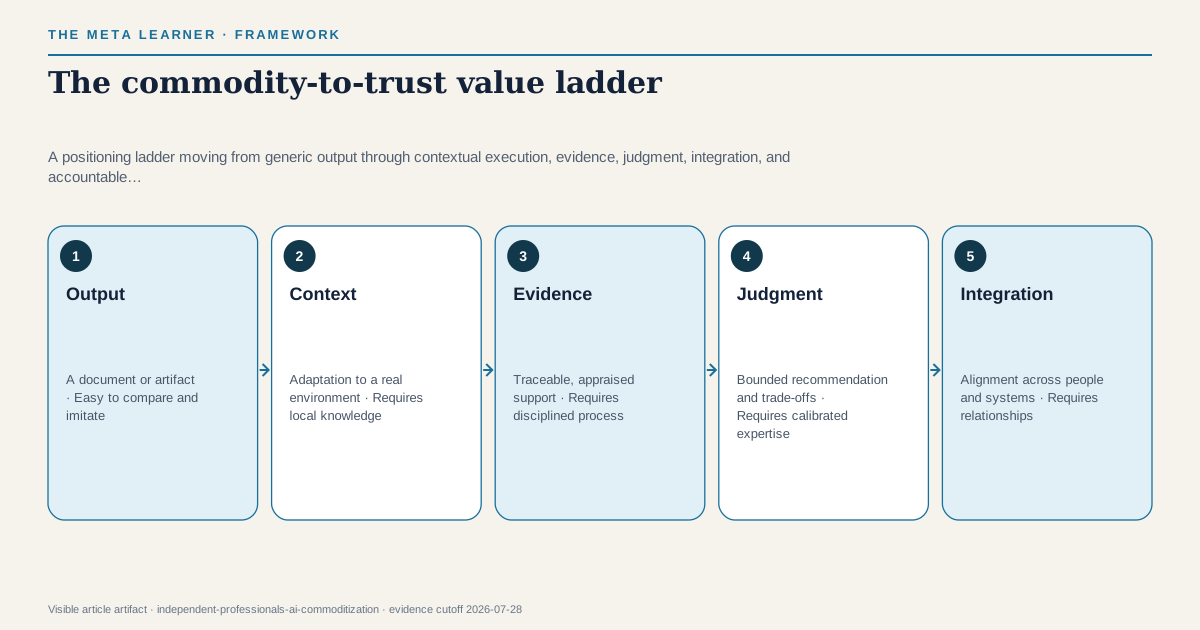
Independent professionals should use AI to reduce low-value production, then reinvest the gain in advantages that generic output cannot supply by itself: access to the right problem, domain context, verified evidence, integration across stakeholders, clear trade-offs, and accountability for an outcome. Sell a bounded decision or changed capability—not pages, slides, or hours alone.
Generic output is becoming easier to imitate
Reports, designs, code drafts, translations, and research summaries can now be produced faster by more people. That does not make every service worthless. It changes the buyer’s reference point: polished output is weaker proof of rare capability.
ILO research estimates occupational exposure from tasks, while emphasizing that transformation differs from simple job replacement.ilo-exposure, oecd-ai-skills, sba-market, nber-genai-work Independent professionals should apply the same task logic to their offer.
Decompose the service
Map:
- problem discovery;
- access to information or people;
- source and data selection;
- analysis or production;
- verification;
- decision facilitation;
- implementation;
- accountability and correction.
Mark which stages AI makes cheaper, which it makes more important, and which require permission or trust. A generic research draft may commoditize; access to a specialized bilingual evidence base and responsibility for the recommendation may not.
The commodity-to-trust ladder
| Level | Offer | Competitive pressure | |---|---|---| | Output | A document or artifact | Easy to compare and imitate | | Context | Adaptation to a real environment | Requires local knowledge | | Evidence | Traceable, appraised support | Requires disciplined process | | Judgment | Bounded recommendation and trade-offs | Requires calibrated expertise | | Integration | Alignment across people and systems | Requires relationships | | Outcome | Accountable change and correction | Requires trust and authority |
Move upward only where you can produce evidence. “Strategic” is not a level; a client decision, its reasoning, and result are.
Official evidence supports uneven task exposure and changing skill needs. SBA guidance supports direct and secondary market research, competitive analysis, demand, saturation, and pricing questions. It does not prove that trust-based positioning succeeds in every professional market.
Claim sources: oecd-ai-skills, ilo-exposure, sba-market, nber-genai-work
Use AI behind the promise
AI can assist:
- query expansion;
- comparison formatting;
- first-pass classification;
- scenario generation;
- routine drafting;
- internal quality checks.
Do not make unverified AI capability the client promise. Define your standard, data boundary, review, escalation, and disclosure. Preserve source records and corrections.
OECD analysis emphasizes that the AI-age skill mix includes foundational, digital, managerial, and human capabilities, with effects varying across contexts.oecd-ai-skills Your operating system should make those complements visible.
Build proprietary learning without proprietary claims
A defensible advantage can come from:
- structured observations across projects;
- reusable rubrics and failure libraries;
- lawful domain datasets;
- relationships and permissioned interviews;
- decision records;
- cross-language or cross-industry synthesis;
- a reliable correction process.
Do not label public data “proprietary” or expose client information. The asset is often the method and accumulated judgment, not ownership of every input.
Evidence-bounded case: the commodity-to-trust value ladder
A freelance presentation designer faces AI-generated slides.
- Output-only offer: “I create 30 slides.”
- Trust offer: “I turn one consequential executive decision into a narrative whose claims are source-traceable, whose alternatives are visible, and whose stakeholders can act.”
AI assists layout alternatives and image ideation. The professional interviews the decision owner, audits evidence, builds the argument, tests comprehension, and owns revision. The case does not imply every client will pay more; it defines a hypothesis to test.
Test demand before rebranding
SBA guidance recommends examining demand, market size, saturation, alternatives, barriers, and pricing through secondary and direct research.sba-market
Run:
- five buyer conversations about a specific decision;
- competitor and substitute analysis, including in-house AI;
- one paid pilot where possible;
- a before-and-after outcome measure;
- a post-project question about what the client actually valued.
Signals of appreciation are not payment evidence. Preserve the difference.
Climb the commodity-to-trust ladder
- Decompose one current offer.
- identify commoditizing stages.
- choose one higher-level client outcome.
- define evidence and accountability.
- redesign the workflow with AI behind the promise.
- create a work sample.
- test with a real buyer.
- keep, narrow, or reject the positioning.
Use Audit Your Work for Automation, Augmentation, and Human Judgment, demonstrate the result in Build a Skill Portfolio for an AI-Shaped Career, and use Critical Thinking: A Practical System for Claims and Evidence to strengthen the evidence layer.
Differentiation that remains generic
- “Human touch” without a task or outcome.
- “AI-powered” without evaluation.
- “Strategy” that delivers only slides.
- volume discounts that accelerate commoditization.
- proprietary-language claims around public information.
- social proof with no relevant work sample.
- hiding AI use where disclosure is required.
Run a two-offer test before repositioning the whole business. Present one narrowly defined output offer and one decision-grade offer that includes source provenance, contextual interviews, trade-offs, and correction responsibility. Ask qualified prospects what decision each would support, what evidence is missing, and what failure would cost. Do not infer pricing power from compliments. The NBER customer-support study shows that deployed assistance can affect performance differently across workers; it does not establish a market for every AI-enabled service.nber-genai-work Only repeated buyer behavior, delivery economics, and retained trust can show whether the higher rung is real.
Positioning is not demand
Markets differ by geography, language, regulation, buyer maturity, economic cycle, reputation, and distribution. Independent work carries income, tax, insurance, legal, and bargaining risks. A differentiated offer can still fail. Validate with authorized buyer research and paid behavior before making costly commitments.
Do not compete with AI on how much generic work can be produced. Compete on whether the work can be trusted to change the right thing.
Named sources
Evidence and further reading
Published July 29, 2026. No substantive revision has been recorded. Evidence last verified July 28, 2026.