How to Document AI-Assisted Work So Others Can Judge Your Contribution
Document goals, sources, human decisions, AI transformations, verification, corrections, and final ownership so contribution remains inspectable.
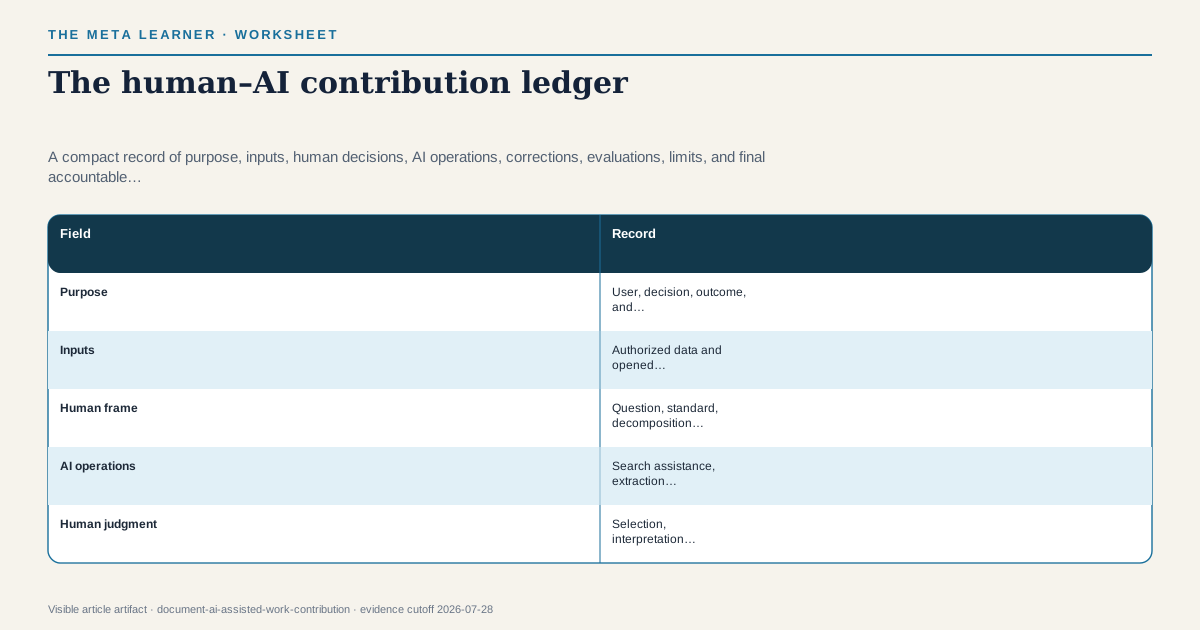
Document AI-assisted work with a contribution ledger: the problem and constraints, source inputs, decisions you made, operations assigned to AI, rejected or corrected output, evaluation method, final result, and person accountable. Include enough intermediate evidence for another evaluator to see your judgment. Disclose AI use accurately, but never expose protected data or imply that a tool’s output proves your skill.
The polished-artifact problem
An evaluator sees an excellent report. Did the candidate frame the problem, select evidence, design the analysis, and correct errors—or ask a model to produce the whole artifact? Conversely, did the person build a sophisticated evaluation system that disappears behind the final prose?
Without process evidence, both human contribution and AI risk become hard to judge.
The answer is not a transcript dump. Long chat logs obscure decisions and may contain confidential material. Use a structured ledger tied to the work.
Adoption case: the human–AI contribution ledger
An analyst publishes a sanitized portfolio case about an AI-assisted research brief.
The ledger shows:
- the public research question and source criteria;
- AI used for query expansion and table formatting;
- human-opened sources and claim decisions;
- two invented citations rejected;
- a peer’s rubric scores;
- the final evidence map;
- confidential client context removed with permission.
The case demonstrates research judgment and AI control. It does not reveal prompts containing protected data or claim employer endorsement.
The contribution ledger
| Field | Record | |---|---| | Purpose | User, decision, outcome, and constraints | | Inputs | Authorized data and opened sources | | Human frame | Question, standard, decomposition, exclusions | | AI operations | Search assistance, extraction, comparison, draft, transformation | | Human judgment | Selection, interpretation, trade-offs, approval | | Corrections | Material model errors and changes | | Evaluation | Cases, rubric, reviewer, and result | | Boundary | Unknowns, prohibited use, and non-transfer | | Ownership | Person responsible for final output |
Use version IDs rather than reproducing sensitive content.
NIST and GAO frameworks emphasize documentation, governance, data, performance, and monitoring. OPM describes the value and constraints of realistic work samples. These sources support inspectability, not a universal disclosure format or employment rule.
Claim sources: nist-genai, gao-accountability, opm-work-samples, nber-genai-work
Show decisions, not prompt cleverness
Prompts are evidence only when they encode a meaningful procedure. More important:
- Why was this question chosen?
- Which source was excluded and why?
- What standard defined quality?
- Which AI suggestion was rejected?
- How was a contradiction resolved?
- What triggered escalation?
- What would change the conclusion?
These demonstrate judgment that can transfer beyond one interface.
Preserve material corrections
Choose three to five examples:
- original AI output or summary;
- error classification;
- source or standard used to detect it;
- corrected result;
- workflow change preventing recurrence.
NIST’s Generative AI Profile addresses risks including confabulation and information integrity.nist-genai, gao-accountability, opm-work-samples, nber-genai-work Showing correction is not confessing incompetence; it is evidence that the process can detect and learn from failure.
Make the work sample realistic
OPM guidance describes work samples as tasks similar to actual job work and notes that assessment should consider job relevance, validity, costs, and applicant readiness.opm-work-samples Your portfolio is not a formal selection instrument, but it should still represent the target task.
Include:
- realistic input complexity;
- time or resource constraints;
- evaluator-relevant output;
- a rubric;
- independent feedback;
- limitation.
Do not create a glossy artifact that avoids the role’s hardest decision.
Distinguish contribution from ownership
Several people and tools can contribute:
- domain owner defines standard;
- analyst selects evidence;
- AI clusters material;
- editor improves clarity;
- legal reviewer sets a restriction;
- manager approves action.
Document those roles. Do not claim sole authorship where collaboration was material. Do not let collaborative creation erase who owns the final decision.
GAO’s framework emphasizes governance, data, performance, and monitoring as complementary accountability principles.gao-accountability The contribution ledger should connect to those organizational systems where relevant.
Complete the contribution ledger
- Confirm what may be disclosed.
- name the real task and standard.
- list AI operations by stage.
- capture human decisions and material corrections.
- attach source and evaluation evidence.
- state collaborators and final owner.
- remove protected detail without making the case misleading.
- ask an evaluator whether contribution is judgeable.
Place the case in Build a Skill Portfolio for an AI-Shaped Career, retain source evidence through Verify AI Explanations and Sources, and map ownership with Audit Your Work for Automation, Augmentation, and Human Judgment.
Disclosure that clarifies nothing
- “AI was used” with no task.
- listing tools but not decisions.
- sharing an entire chat log.
- hiding AI involvement because the final text was edited.
- claiming prompt authorship as domain capability.
- showing corrections without the standard that found them.
- deleting collaborator roles.
Make the ledger comparable across work samples. Use the same categories—problem framing, evidence access, AI transformation, human correction, decision, and result—while allowing domain-specific detail. Then ask a reviewer to identify what capability the record actually demonstrates. The NBER field study shows that effects can vary by worker experience inside one deployment, a useful reminder that a polished artifact does not reveal the contribution distribution by itself.nber-genai-work A credible record lets an evaluator see both leverage and limits: where AI accelerated the workflow, where human judgment changed it, and which claims remain unearned.
Where evidence cannot be disclosed, describe the verification method and permission boundary without fabricating or exposing protected detail.
Transparency has permission boundaries
Do not publish confidential, personal, copyrighted, security-sensitive, privileged, or employer-owned material without authority. Disclosure duties vary by organization, profession, school, client, platform, and jurisdiction. A contribution ledger cannot prove authorship, eliminate bias, or guarantee fair evaluation.
The purpose of disclosure is not ritual purity. It is to let another person see what you understood, decided, tested, and owned.
Named sources
Evidence and further reading
Published July 29, 2026. No substantive revision has been recorded. Evidence last verified July 28, 2026.