The Career Adjacency Map: Move Into a New Field Without Starting From Zero
Map reusable tasks, knowledge, relationships, evidence, and missing standards to design a career transition that preserves real advantage.
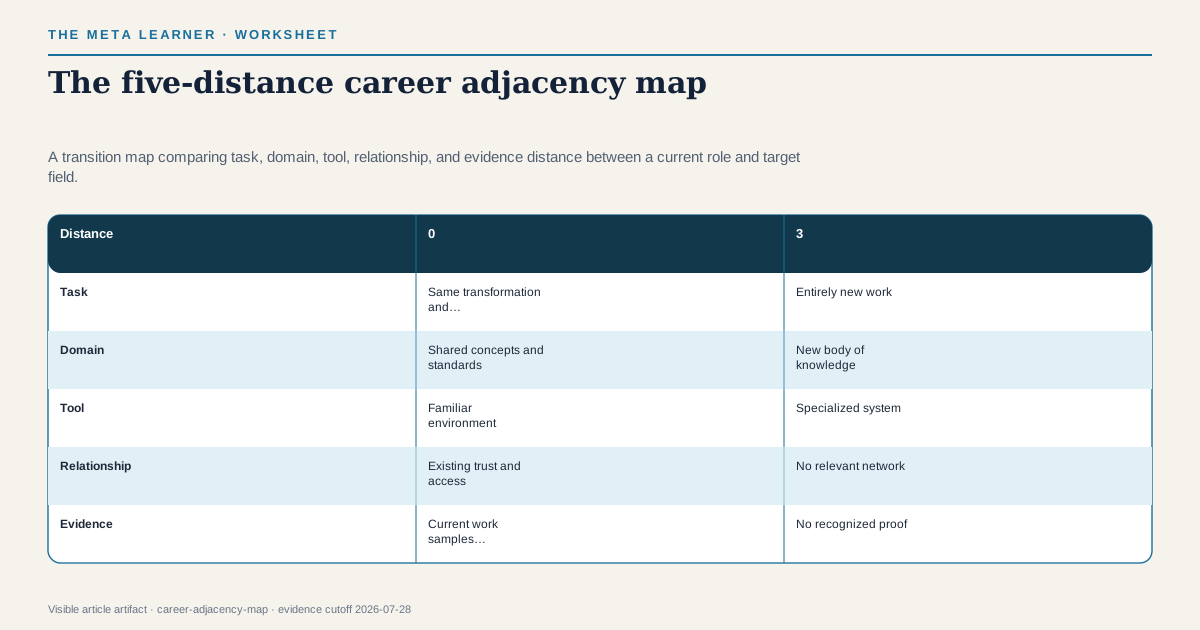
Map a career transition across five distances: tasks, domain knowledge, tools, relationships, and evidence. Preserve what already transfers, identify the few gaps that block trusted performance, and test the target role through a realistic work sample or bounded project. Do not begin with a new title or generic skill list; begin with the actual work and the standards by which it is judged.
Titles conceal transferable work
A teacher, customer-success lead, researcher, and product manager may all interview people, diagnose misunderstanding, synthesize evidence, design explanations, and coordinate decisions. Their titles hide shared tasks—and hide domain standards that do not transfer automatically.
Career adjacency is the measured distance between your current capability system and a target role. It is not a motivational claim that “all skills transfer.” Some do; some change meaning; some require credentials, supervised practice, or local trust.
OECD adult-career guidance emphasizes pathways, information, skills assessment, and targeted gaps rather than treating transition as a one-time choice.oecd-guidance, oecd-skills-outlook, onet-content, nber-genai-work
The five distances
Score current-to-target distance from 0 to 3:
| Distance | 0 | 3 | |---|---|---| | Task | Same transformation and consequence | Entirely new work | | Domain | Shared concepts and standards | New body of knowledge | | Tool | Familiar environment | Specialized system | | Relationship | Existing trust and access | No relevant network | | Evidence | Current work samples transfer | No recognized proof |
Do not add the scores into a mystical career number. Use the pattern. Low task distance and high domain distance suggests targeted study plus supervised cases. Low domain distance and high evidence distance suggests a portfolio problem. High relationship distance suggests the transition needs access, not another course.
OECD guidance supports adult career information, assessment, counseling, and pathways, while O*NET provides granular task and capability structures. The five-distance map is an editorial decision aid; it has not been validated as a predictor of individual transition success.
Claim sources: oecd-guidance, oecd-skills-outlook, onet-content, nber-genai-work
Decompose both roles
Use O*NET or another official occupational framework as a starting vocabulary, then compare real local roles.onet-content
For current and target work, record:
- recurring tasks and work activities;
- decisions and consequence;
- knowledge and standards;
- tools and data;
- stakeholders and trust;
- expected entry evidence;
- learning pathway and feedback.
Job postings show demand language but can contain inflated or copied requirements. Interview practitioners and observe public work where permitted; do not rely on postings alone.
Find the transfer unit
“Communication” is too broad. A stronger transfer unit has task, context, and standard:
- explaining a complex policy to non-specialists with accurate boundaries;
- interviewing users and converting evidence into prioritized requirements;
- synthesizing multilingual sources into a traceable market decision;
- coordinating an incident across technical and executive teams.
Now another person can inspect whether the capability survives the new context.
Identify blocking gaps
Classify gaps:
- knowledge: concepts and causal models;
- procedure: steps, tools, and fluency;
- standard: what good and safe work requires;
- context: exceptions and tacit constraints;
- authority: credential, license, or permission;
- proof: evidence recognized by gatekeepers;
- access: relationships and opportunities to perform.
The OECD Skills Outlook notes that changing occupations and skill requirements make guidance and targeted adult learning important, with outcomes shaped by unequal opportunity.oecd-skills-outlook A course may close knowledge distance while leaving access and evidence untouched.
Evidence-bounded case: the five-distance career adjacency map
A journalist wants to move into user research.
Transferable units include interviewing, follow-up questions, source skepticism, synthesis, and concise reporting. Gaps include consent procedures, research planning, participant sampling, product context, repository practice, and translating findings into design decisions.
A bounded bridge project uses a nonprofit’s low-risk public service, an approved research plan, supervised interviews, a coded evidence set, and a presentation showing how findings changed one decision. It is not represented as equivalence to years of product research.
Design the bridge
Choose the smallest project that tests the highest-distance, highest-consequence part of the target role. Define:
- target task;
- real or realistic input;
- rubric from the target field;
- authorized context;
- reviewer with relevant experience;
- correction cycle;
- public or private evidence artifact;
- stop rule if ethics or access are inadequate.
The goal is evidence and error discovery, not free labor disguised as transition.
Draw the five-distance map
- Audit your current tasks.
- Select two plausible target roles.
- map the five distances for each.
- Identify three transfer units.
- Mark the blocking gaps.
- Design one ethical bridge project.
- Get a target-field reviewer’s feedback.
- Update the transition hypothesis before buying training or resigning.
Start with Audit Your Work for Automation, Augmentation, and Human Judgment, turn bridge evidence into Build a Skill Portfolio for an AI-Shaped Career, and organize gap practice through How to Build a Personal Learning System.
Transitions that mistake similarity for access
- Renaming generic skills without showing target performance.
- Ignoring credentials or regulated scope.
- Choosing a target from trend headlines rather than local work.
- Taking a broad course before locating the blocking gap.
- Building speculative portfolio pieces no evaluator wants.
- Asking unpaid contacts for unlimited mentorship.
- Hiding novice status instead of designing supervised practice.
Treat the map as a sequence of falsifiable bridge tests. A portfolio sample can test task similarity; a practitioner review can test quality standards; a short supervised project can expose contextual gaps; an official credential check can settle access. The NBER field study of AI assistance in customer support also shows why a tool-mediated performance gain in one setting should not be mistaken for occupational readiness elsewhere.nber-genai-work Advance only when the next test reduces a named distance. If evidence reveals a larger authority, identity, or access gap than expected, redesign the route instead of collecting more generic training.
Adjacent is not accessible
Skill overlap does not guarantee hiring, pay, visa access, credential recognition, accommodation, or social acceptance. Occupational databases are descriptive and can lag changing work. Transitions into regulated, clinical, legal, safety, or licensed fields require formal pathways. Use local labor evidence, qualified career guidance, and financial constraints before committing.
A strong transition story does not erase the past or romanticize the future. It shows the distance, the bridge, and the evidence that you crossed.
Named sources
Evidence and further reading
Published July 29, 2026. No substantive revision has been recorded. Evidence last verified July 28, 2026.