When Should an AI Task Escalate to a Human? A 120-Task Cost Curve
How do four human-review thresholds trade review cost against expected error loss across tasks with different consequences and reversibility? Executed on frozen inputs with inspect
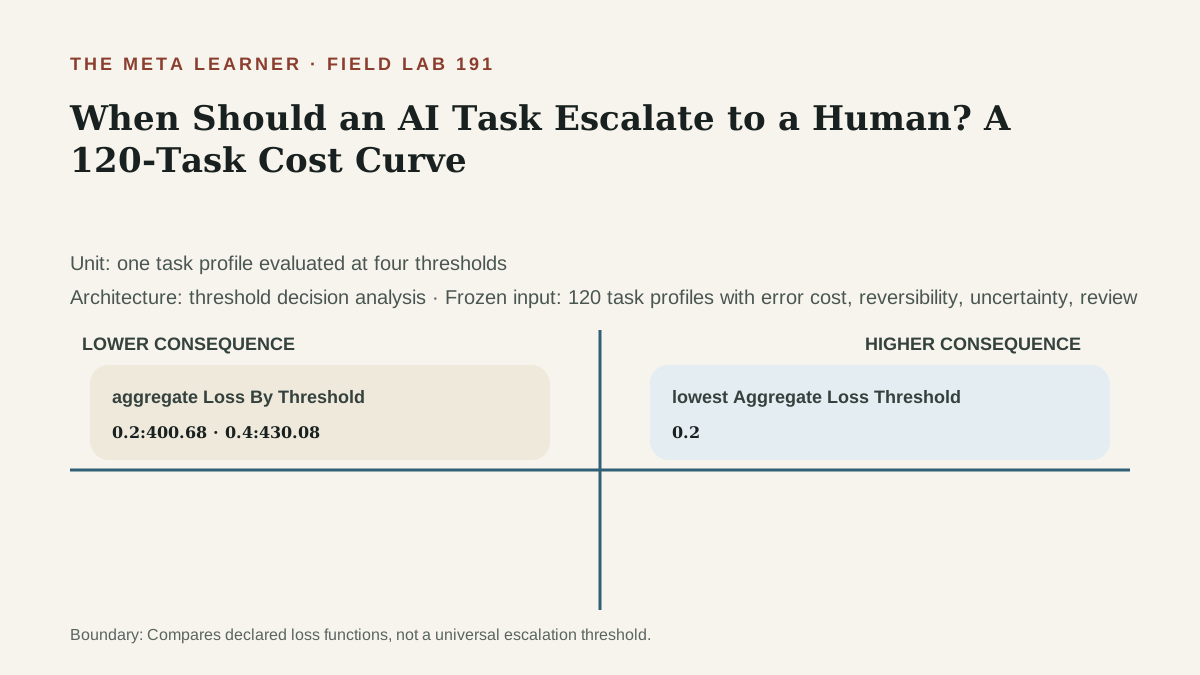
Under the declared model, aggregate loss varied across thresholds, and no single threshold minimized loss for every combination of error cost, review cost, and reversibility. Set routing from expected consequence and review cost, then recalibrate with observed errors rather than provider confidence labels alone. The result is conditional on the costs, permissions, and observability encoded in one task profile evaluated at four thresholds, not a forecast of human behavior.
Confidence is not consequence
“Human oversight” in human-review thresholds for AI tasks names an aspiration, not yet a control. The predetermined research question is: How do four human-review thresholds trade review cost against expected error loss across tasks with different consequences and reversibility? Here, one task profile evaluated at four thresholds is a modeled decision unit. The cost-sensitive escalation simulation reveals the consequences of its declared rules; it does not estimate how real reviewers behave.
A single confidence threshold treats a reversible low-cost draft and an irreversible high-cost action as if their errors had equal consequences. By design, the cost-sensitive escalation model is severe. Its value for human-review thresholds for AI tasks lies in making assumptions about visibility, cost, capacity, and authority explicit enough to challenge.
Frozen cost-sensitive escalation cases cross tasks: 120; thresholds: reported in the raw record. No participant was recruited for this human-review thresholds for AI tasks model; the rows are consequences of its declared conditions.
Results: what the cost-sensitive escalation model did under its declared rules
| Recorded result | Value | |---|---| | aggregate Loss By Threshold | 0.2=400.68; 0.4=430.08; 0.6=550.2; 0.8=761.04 | | lowest Aggregate Loss Threshold | 0.2 |
Under the declared cost-sensitive escalation rules, aggregate loss varied across thresholds, and no single threshold minimized loss for every combination of error cost, review cost, and reversibility. The human-review thresholds for AI tasks result is conditional on those rules. Altering consequence, capacity, or authority can reverse this cost-sensitive escalation design without contradicting the run.
The prespecified negative finding for cost-sensitive escalation is equally important: No threshold minimized loss for every task; cheap review favored earlier escalation while expensive review changed the tradeoff. It marks the point at which this human-review thresholds for AI tasks method becomes silent, a condition a reader needs before deciding whether to use the rule.
The case for a lighter control
A simple threshold remains useful when a workflow is narrow and stable. The error is not simplicity itself, but pretending that the same score has the same consequence across drafting, advice, and irreversible action.
Taken seriously, the cost-sensitive escalation countercase turns the result into a decision boundary. A lighter human-review thresholds for AI tasks checkpoint is justified when consequence and uncertainty are low; stronger control requires observability or authority that can change release behavior.
That reversal condition keeps cost-sensitive escalation from becoming either technological maximalism or ritual caution. The human-review thresholds for AI tasks procedure earns its place only when it makes a consequential uncertainty, tradeoff, or failure more visible.
One hundred twenty tasks draw a cost curve
The simulation applies its control logic in 3 explicit stages:
- Freeze one hundred twenty task profiles with error probability, error cost, review cost, and reversibility.
- Apply four escalation thresholds without tuning them after inspecting results.
- Calculate total declared loss and retain each task's threshold-specific result.
Across the cost-sensitive escalation diagram and JSON, the same unit, sample, and result fields remain visible. If those human-review thresholds for AI tasks representations disagree, the visual is wrong; visual polish cannot override the canonical executed record.
Follow the cost-sensitive escalation decisions row by row
The complete sanitized raw data is the canonical record for this run. At row level, cost-sensitive escalation makes modeled conjunctions and losses inspectable. It is a trace of declared human-review thresholds for AI tasks logic, not a sample of organizational life.
- Row 1 — task Id: A001; error Probability: 0.1; error Cost: 1; review Cost: 0.5; reversible: false; loss By Threshold: 0.2=0.1, 0.4=0.1, 0.6=0.1; lowest Loss Threshold: 0.2.
- Row 2 — task Id: A002; error Probability: 0.2; error Cost: 1; review Cost: 0.5; reversible: true; loss By Threshold: 0.2=0.5, 0.4=0.08, 0.6=0.08; lowest Loss Threshold: 0.4.
- Row 3 — task Id: A003; error Probability: 0.3; error Cost: 1; review Cost: 0.5; reversible: true; loss By Threshold: 0.2=0.5, 0.4=0.12, 0.6=0.12; lowest Loss Threshold: 0.4.
- Row 4 — task Id: A004; error Probability: 0.4; error Cost: 1; review Cost: 0.5; reversible: false; loss By Threshold: 0.2=0.5, 0.4=0.5, 0.6=0.4; lowest Loss Threshold: 0.6.
- Row 5 — task Id: A005; error Probability: 0.5; error Cost: 1; review Cost: 0.5; reversible: true; loss By Threshold: 0.2=0.5, 0.4=0.5, 0.6=0.2; lowest Loss Threshold: 0.6.
- Row 6 — task Id: A006; error Probability: 0.6; error Cost: 1; review Cost: 0.5; reversible: true; loss By Threshold: 0.2=0.5, 0.4=0.5, 0.6=0.5; lowest Loss Threshold: 0.8.
- Row 7 — task Id: A007; error Probability: 0.7; error Cost: 1; review Cost: 0.5; reversible: false; loss By Threshold: 0.2=0.5, 0.4=0.5, 0.6=0.5; lowest Loss Threshold: 0.2.
- Row 8 — task Id: A008; error Probability: 0.8; error Cost: 1; review Cost: 0.5; reversible: true; loss By Threshold: 0.2=0.5, 0.4=0.5, 0.6=0.5; lowest Loss Threshold: 0.2.
- Row 9 — task Id: A009; error Probability: 0.9; error Cost: 1; review Cost: 0.5; reversible: true; loss By Threshold: 0.2=0.5, 0.4=0.5, 0.6=0.5; lowest Loss Threshold: 0.2.
- Row 10 — task Id: A010; error Probability: 1; error Cost: 1; review Cost: 0.5; reversible: false; loss By Threshold: 0.2=0.5, 0.4=0.5, 0.6=0.5; lowest Loss Threshold: 0.2.
- Row 11 — task Id: A011; error Probability: 0.1; error Cost: 5; review Cost: 0.5; reversible: true; loss By Threshold: 0.2=0.2, 0.4=0.2, 0.6=0.2; lowest Loss Threshold: 0.2.
- Row 12 — task Id: A012; error Probability: 0.2; error Cost: 5; review Cost: 0.5; reversible: true; loss By Threshold: 0.2=0.5, 0.4=0.4, 0.6=0.4; lowest Loss Threshold: 0.4.
- Row 13 — task Id: A013; error Probability: 0.3; error Cost: 5; review Cost: 0.5; reversible: false; loss By Threshold: 0.2=0.5, 0.4=1.5, 0.6=1.5; lowest Loss Threshold: 0.2.
- Row 14 — task Id: A014; error Probability: 0.4; error Cost: 5; review Cost: 0.5; reversible: true; loss By Threshold: 0.2=0.5, 0.4=0.5, 0.6=0.8; lowest Loss Threshold: 0.2.
- Row 15 — task Id: A015; error Probability: 0.5; error Cost: 5; review Cost: 0.5; reversible: true; loss By Threshold: 0.2=0.5, 0.4=0.5, 0.6=1; lowest Loss Threshold: 0.2.
- Row 16 — task Id: A016; error Probability: 0.6; error Cost: 5; review Cost: 0.5; reversible: false; loss By Threshold: 0.2=0.5, 0.4=0.5, 0.6=0.5; lowest Loss Threshold: 0.2.
- Row 17 — task Id: A017; error Probability: 0.7; error Cost: 5; review Cost: 0.5; reversible: true; loss By Threshold: 0.2=0.5, 0.4=0.5, 0.6=0.5; lowest Loss Threshold: 0.2.
- Row 18 — task Id: A018; error Probability: 0.8; error Cost: 5; review Cost: 0.5; reversible: true; loss By Threshold: 0.2=0.5, 0.4=0.5, 0.6=0.5; lowest Loss Threshold: 0.2.
- Row 19 — task Id: A019; error Probability: 0.9; error Cost: 5; review Cost: 0.5; reversible: false; loss By Threshold: 0.2=0.5, 0.4=0.5, 0.6=0.5; lowest Loss Threshold: 0.2.
- Row 20 — task Id: A020; error Probability: 1; error Cost: 5; review Cost: 0.5; reversible: true; loss By Threshold: 0.2=0.5, 0.4=0.5, 0.6=0.5; lowest Loss Threshold: 0.2.
- Row 21 — task Id: A021; error Probability: 0.1; error Cost: 20; review Cost: 0.5; reversible: true; loss By Threshold: 0.2=0.8, 0.4=0.8, 0.6=0.8; lowest Loss Threshold: 0.2.
- Row 22 — task Id: A022; error Probability: 0.2; error Cost: 20; review Cost: 0.5; reversible: false; loss By Threshold: 0.2=0.5, 0.4=4, 0.6=4; lowest Loss Threshold: 0.2.
- Row 23 — task Id: A023; error Probability: 0.3; error Cost: 20; review Cost: 0.5; reversible: true; loss By Threshold: 0.2=0.5, 0.4=2.4, 0.6=2.4; lowest Loss Threshold: 0.2.
- Row 24 — task Id: A024; error Probability: 0.4; error Cost: 20; review Cost: 0.5; reversible: true; loss By Threshold: 0.2=0.5, 0.4=0.5, 0.6=3.2; lowest Loss Threshold: 0.2.
- Row 25 — task Id: A025; error Probability: 0.5; error Cost: 20; review Cost: 0.5; reversible: false; loss By Threshold: 0.2=0.5, 0.4=0.5, 0.6=10; lowest Loss Threshold: 0.2.
- Row 26 — task Id: A026; error Probability: 0.6; error Cost: 20; review Cost: 0.5; reversible: true; loss By Threshold: 0.2=0.5, 0.4=0.5, 0.6=0.5; lowest Loss Threshold: 0.2.
- Row 27 — task Id: A027; error Probability: 0.7; error Cost: 20; review Cost: 0.5; reversible: true; loss By Threshold: 0.2=0.5, 0.4=0.5, 0.6=0.5; lowest Loss Threshold: 0.2.
- Row 28 — task Id: A028; error Probability: 0.8; error Cost: 20; review Cost: 0.5; reversible: false; loss By Threshold: 0.2=0.5, 0.4=0.5, 0.6=0.5; lowest Loss Threshold: 0.2.
The executed cost-sensitive escalation record shows that aggregate loss varied across thresholds, and no single threshold minimized loss for every combination of error cost, review cost, and reversibility. Row-level human-review thresholds for AI tasks fields support that bounded finding, while no field represents human learning, reader comprehension, or real-world deployment.
lab-recordClaim sources: lab-record
The reviewed method source supplies a relevant standard for context, traceability, or explicit evaluation of human-review thresholds for AI tasks. It disciplines interpretation of human-review thresholds for AI tasks; it does not generate or independently confirm this local aggregate.
method-sourceClaim sources: method-source
Route by loss, reversibility, and authority
Set routing from expected consequence and review cost, then recalibrate with observed errors rather than provider confidence labels alone. Re-run cost-sensitive escalation whenever error cost, review cost, reversibility, evidence access, or stop authority changes. A human-review thresholds for AI tasks threshold borrowed from another workflow has no inherited legitimacy.
The working sequence for cost-sensitive escalation is specific to this study: lock the question and baseline, freeze the unit, execute the declared transformation, retain negative findings, and separate the local result from any transfer claim.
The universal threshold is the tempting mistake
A cost-sensitive escalation checkpoint that cannot see, investigate, or stop an error is ceremony. A universal human-review thresholds for AI tasks threshold is equally misleading when it ignores reversibility and treats confidence as consequence.
Reproducibility in human-review thresholds for AI tasks also fails when a download cannot regenerate the claim in the prose. This cost-sensitive escalation record keeps protocol, sample, aggregates, limitations, negative findings, and row-level output in one parseable object so that disagreement can reach the actual computation.
Where this cost-sensitive escalation result stops
Costs and probabilities are frozen design inputs, not estimates from a deployed AI system. The cost-sensitive escalation rows are modeled consequences of chosen inputs, not observations of reviewers, workers, or deployed systems. Real human-review thresholds for AI tasks costs, workarounds, learning, and power can change the boundary.
This cost-sensitive escalation limit specifies the next experiment. Transfer of this human-review thresholds for AI tasks result requires records from the target context, the same visible denominator, and a fresh execution—not stronger adjectives attached to the present run.
Related reading:
- Continue with the prerequisite analysis of cost-sensitive escalation.
- Continue with a comparison that tests a neighboring boundary.
- Continue with the next practical application.
The cost-sensitive escalation boundary is useful only when it changes who can see, question, or stop the decision.
Named sources
Evidence and further reading
Published July 29, 2026. No substantive revision has been recorded. Evidence last verified July 28, 2026.