The Worlds I See: What a Human-Centered History of AI Makes Visible
Test Fei-Fei Li’s human-centered history of computer vision against the labor, labels, institutions, exclusions, and power that make machine seeing possible.
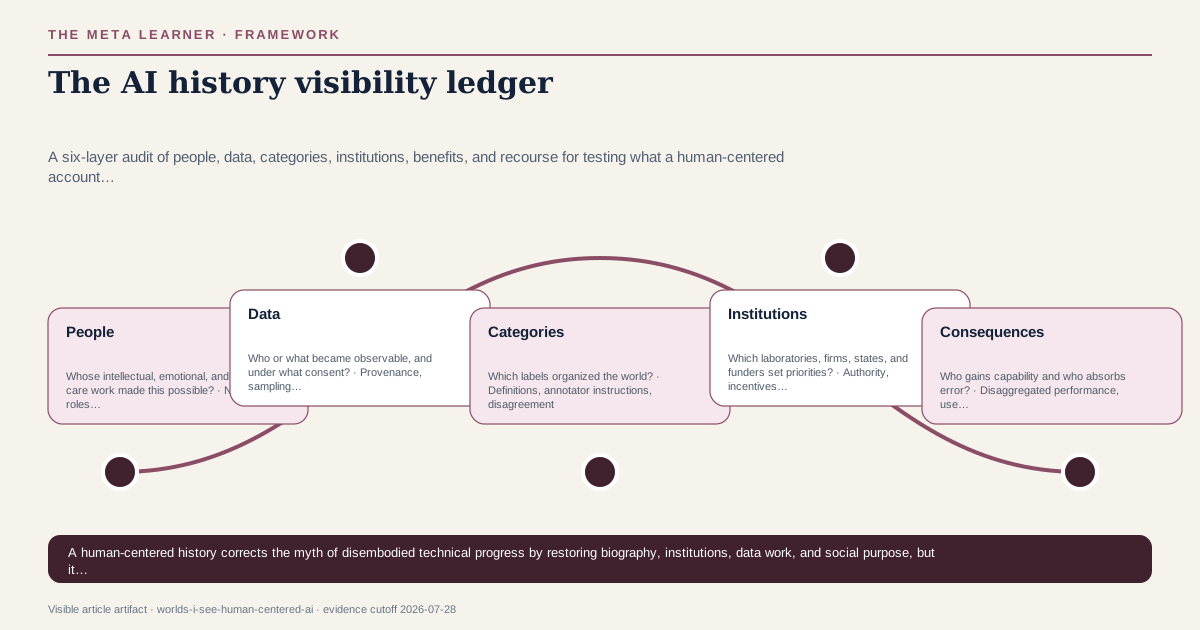
A human-centered history of AI makes visible the people, institutions, data work, categories, ambitions, and consequences that a story of algorithms alone cannot explain. Its test is not whether the word “human” appears in a mission statement. Ask which humans define the purpose, who supplies the data and labor, who receives the benefit, who bears error, and who has recourse.
Reconstructing a human-centered history
Fei-Fei Li’s memoir joins three histories that are often separated: migration and family, scientific formation, and the rise of modern computer vision. Its central argument is not simply that AI needs better values. Scientific possibility is made by particular lives, mentors, institutions, datasets, and acts of imagination; the future of the field should be deliberately oriented toward human dignity and flourishing.
That form matters. A benchmark history can make progress look like a sequence of scores. A corporate history can make it look like products. A memoir can restore contingency: the financial pressure behind a student’s choices, the teachers who opened a path, the institutional resources behind an experiment, and the persistence required before a result became legible.
The book’s argument should nevertheless be tested rather than converted into an inspirational slogan. “Human-centered” can name a research orientation, a design practice, an institutional promise, or public relations. Those meanings do not carry the same obligations.
AI history visibility ledger: the claim-bearing evidence
Li supplies a first-person history of computer vision and the creation of ImageNet. The original ImageNet paper documents a large hierarchical image database intended to support object-recognition research. Gender Shades later demonstrates that apparently impressive aggregate performance can conceal intersectional accuracy disparities. Together they support a history in which data scale enabled progress while category design and unequal error remained material questions.
li-worlds, imagenet-cvpr, gender-shadesClaim sources: li-worlds, imagenet-cvpr, gender-shades
Use the visibility ledger
For any AI history, system, or institution, complete six rows:
| Layer | Visibility question | Evidence to retain | |---|---|---| | People | Whose intellectual, emotional, and care work made this possible? | Names, roles, testimony, compensation | | Data | Who or what became observable, and under what consent? | Provenance, sampling, exclusions | | Categories | Which labels organized the world? | Definitions, annotator instructions, disagreement | | Institutions | Which laboratories, firms, states, and funders set priorities? | Authority, incentives, resource flows | | Consequences | Who gains capability and who absorbs error? | Disaggregated performance, use context | | Recourse | Who can question, correct, refuse, or obtain remedy? | Appeals, ownership, accountable decision makers |
The ledger prevents two opposite distortions. The heroic-inventor story understates collective infrastructure. The abstract “system” story can erase individual agency, sacrifice, and responsibility.
ImageNet as a worked case
ImageNet’s research contribution is not reducible to “more data.” Its hierarchy, sourcing, labeling, scale, and relationship to evaluation made a shared technical object. Researchers could train against a large corpus and compare progress on named tasks. That infrastructure changed what experiments were feasible.
The visibility ledger adds questions the benchmark alone cannot answer. Image categories are not nature’s ready-made inventory. Annotators make judgments; some objects and people are overrepresented; categories carry historical associations; downstream tasks differ from the benchmark; and image subjects may never know how their representation travels.
None of this erases the scientific achievement. It changes the unit of evaluation from a dataset as file to a dataset as a social and technical institution.
Counterevidence against benevolent intent
The strongest counterargument to a human-centered history is that biography and good intention do not predict system effects. A designer can sincerely seek benefit while a deployment reallocates power, increases surveillance, or distributes errors unevenly.
Gender Shades provides a concrete challenge to aggregate reassurance. Commercial gender-classification systems showed materially different error patterns across intersectional groups. The general lesson is not that every vision system shares those exact errors. It is that an average can hide who pays for failure, and a technical label can import contested social categories.
There is counterevidence to purely critical accounts too. Shared datasets can open comparison, accelerate discovery, and make weaknesses measurable. Removing common infrastructure would not by itself make research more just. The practical question is which governance, documentation, participation, and remedy travel with scale.
Intellectual inheritance behind the Worlds I See
The intellectual genealogy begins before contemporary machine learning. Cybernetics asked how organisms and machines perceive, communicate, and control. Cognitive science treated vision as an inference problem rather than a camera. Pattern recognition and statistical learning turned that problem into computational programs. Benchmark culture then made shared datasets and common measures central to cumulative progress.
ImageNet belongs to that lineage, but it altered its scale. The project made millions of labeled images into research infrastructure. Later deep-learning results made the dataset part of a canonical progress narrative. A second genealogy—human-computer interaction, participatory design, disability studies, science and technology studies, and algorithmic accountability—asks who defines the problem and who encounters the resulting system.
These lineages should not be collapsed. One explains how machine perception became tractable; the other reveals why tractability is not yet legitimacy.
A human-centered institutional test
Before accepting the label, ask four harder questions.
First, does the institution expose the purpose and the interests that may conflict? Second, can affected people influence categories and deployment conditions before harm occurs? Third, are performance and error reported for the populations and contexts that matter? Fourth, is there an accountable path to correction, refusal, and remedy?
A laboratory may pass some tests and fail others. The framework is diagnostic, not a certification. It forces an aspiration into inspectable commitments.
What the memoir form can and cannot do
Memoir preserves dimensions that technical papers deliberately exclude: uncertainty, obligation, grief, belonging, mentorship, and the moral sources of scientific ambition. Those are not decorative. They explain what problems become worth a life’s work.
But memory is selective, and a prominent scientist occupies a particular vantage point. Labor history, organizational records, community testimony, and independent audits remain necessary. A human-centered history becomes broader by placing perspectives in relation, not by asking one narrator to represent everyone.
Human-centered category errors
- Treating “human” as a single interest rather than a conflict among people.
- Celebrating the scientist while hiding annotators, subjects, and maintainers.
- Treating benchmark improvement as demonstrated public benefit.
- Inferring fairness from aggregate accuracy.
- Replacing governance with a design workshop.
- Describing participation without showing who could change the decision.
- Treating a memoir as a complete institutional history.
The boundary of this reading of the Worlds I See
This analysis tests a memoir against a foundational dataset paper and an independent disparity study; it is not a comprehensive history of computer vision or a current audit of any deployed product. “Human-centered” has no single operational definition. Consequential deployments require current technical evidence, legal and institutional analysis, affected-community participation, and named accountability at the authorized publication cutoff.
Continue from history to the value-translation chain, test institutional purpose through The Technological Republic, and protect plural judgment against epistemic monoculture.
Named sources
Evidence and further reading
Published July 29, 2026. No substantive revision has been recorded. Evidence last verified July 28, 2026.