RAG vs Fine-Tuning vs Long Context: Which Knowledge Strategy Fits?
Compare retrieval-augmented generation, fine-tuning, and long context by the problem each solves, its evidence trail, update path, cost, and failure modes.
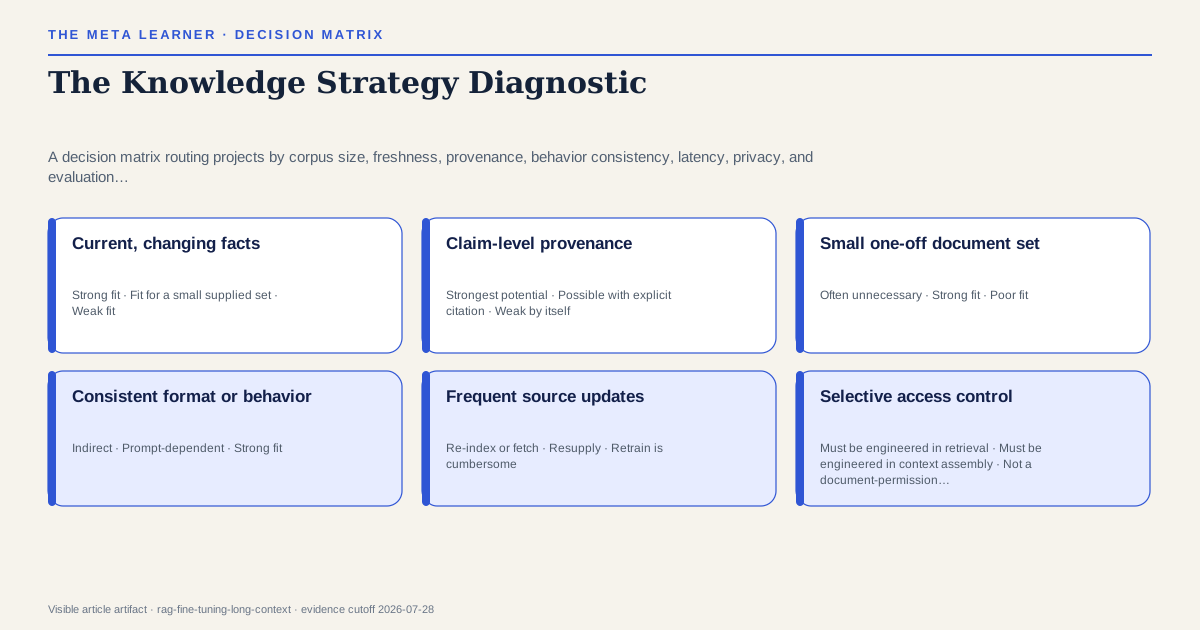
Use RAG when the system must retrieve current, traceable evidence from a larger corpus; use long context when a bounded set of documents can be supplied for one task; use fine-tuning when you need more consistent behavior, format, or domain task performance across many examples. Fine-tuning is not a dependable substitute for current source retrieval.
Diagnose the missing capability before choosing architecture
“The model does not know our business” can mean at least three things:
- It cannot access the relevant documents.
- It sees the documents but fails to select or use the right evidence.
- It understands the inputs but performs the task inconsistently.
Those problems point to different interventions. Retrieval-augmented generation joins a model with externally retrieved material. rag, middle, openai, nist Long-context research shows that merely fitting information into a context does not guarantee equal use of every part. middle Current optimization guidance places prompting, evaluation, and fine-tuning in an iterative system rather than treating training as a first move. openai
What each strategy changes
RAG: changes the evidence supplied
A retrieval system indexes a corpus, selects candidate passages for a query, and gives them to a model. Its strengths are updateability and provenance. Its failure modes include poor chunking, wrong retrieval, stale indexes, access-control leakage, and synthesis beyond the passages.
Long context: changes the working set
You place the relevant documents directly into the current request or conversation. This is simple when the corpus is bounded and known in advance. Failure can come from attention dilution, conflicting passages, ordering, cost, or the model overlooking material.
Fine-tuning: changes learned behavior
Training on examples can improve consistency of style, format, classification, or task behavior. It is useful when you can define good demonstrations and evaluate generalization. Facts embedded in weights are harder to update, trace, and selectively revoke than external documents.
The diagnostic matrix
| Requirement | RAG | Long context | Fine-tuning | |---|---:|---:|---:| | Current, changing facts | Strong fit | Fit for a small supplied set | Weak fit | | Claim-level provenance | Strongest potential | Possible with explicit citation | Weak by itself | | Small one-off document set | Often unnecessary | Strong fit | Poor fit | | Consistent format or behavior | Indirect | Prompt-dependent | Strong fit | | Frequent source updates | Re-index or fetch | Resupply | Retrain is cumbersome | | Selective access control | Must be engineered in retrieval | Must be engineered in context assembly | Not a document-permission system | | Debuggable knowledge path | Inspect retrieved passages | Inspect supplied context | Harder to attribute |
Hybrid systems are common. A fine-tuned model can use retrieval; a long context can hold retrieved passages. The matrix identifies the primary bottleneck.
What survives the comparison: the Knowledge Strategy Diagnostic
Research distinguishes external retrieval from in-context use and documents positional and selection weaknesses in long contexts. Practitioner guidance treats fine-tuning as one optimization path supported by evals. No strategy guarantees factuality, citation fidelity, or good task performance without local testing.
rag, middle, openai, nistA decision sequence
Ask in order:
- Can a better request plus approved examples solve the problem?
- Is the required material small, known, and stable enough to supply directly?
- Must the system search a larger or changing corpus with provenance?
- Is the remaining failure behavioral and repeated enough to justify tuning?
This order is economical because architecture adds new failure surfaces. Retrieval requires indexing and permissions. Fine-tuning requires curated data, training, evaluation, and governance. Long context may increase cost and still need evidence selection.
A worked case
A policy team wants answers from 4,000 internal documents. Policies change monthly, users have different access rights, and every answer must cite the governing passage.
Fine-tuning on the documents would weaken updateability and provenance. Supplying all documents in every context would be expensive and make selection difficult. A retrieval layer is the natural candidate—but only if it enforces document permissions, versions sources, tests recall, and checks that citations support claims.
Fine-tuning might later help classify query intent or produce a stable answer format. It would complement, not replace, the evidence path.
Run a three-strategy bake-off
- Build twenty representative questions with known source passages.
- Define retrieval recall, answer fidelity, citation quality, latency, and cost.
- Test a strong prompt with bounded long context.
- Test retrieval with transparent passages and access controls.
- Test tuning only if a repeated behavioral error remains.
- Compare errors by layer, not only final answer score.
- Select the simplest system that clears blockers and beats the baseline.
Name a decision owner for the architecture choice and a human checkpoint for claims the system cannot safely resolve. That owner should see retrieval misses, unsupported answers, access-control failures, and tuning regressions—not only a blended evaluation score. If no one can inspect the source path or stop release after a blocker, the architecture is not accountable regardless of benchmark performance.
Clarify the task with the High-Quality AI Request, route the retrieval use case with AI Search vs Chatbots vs Agents, and measure it with AI Evals for Knowledge Work.
Expensive solutions to the wrong problem
- Fine-tuning because a prompt lacks success criteria.
- RAG when the needed five pages are already known.
- Long context as a substitute for retrieval evaluation.
- Training on confidential documents without a data-governance decision.
- Measuring answer fluency but not retrieval recall.
- Citing retrieved passages without checking entailment.
- Choosing architecture from a provider's maximum context figure alone.
Architecture labels do not guarantee quality
This comparison abstracts away model-specific limits, embedding quality, rerankers, caching, latency, cost, licensing, data residency, and security. Product capabilities and prices are time-sensitive and must be verified immediately before a build or publication. Fine-tuning methods also vary substantially. A qualified engineering and domain review is required for consequential systems.
Choose architecture by the missing capability: evidence access, working-set assembly, or repeated behavior. The label is not the solution; the evaluated system is.
Named sources
Evidence and further reading
Published July 29, 2026. No substantive revision has been recorded. Evidence last verified July 28, 2026.