AI Search vs Chatbots vs Agents: Which Should You Use for Which Task?
Choose among AI search, conversational models, and tool-using agents by matching evidence needs, action scope, reversibility, and required oversight.
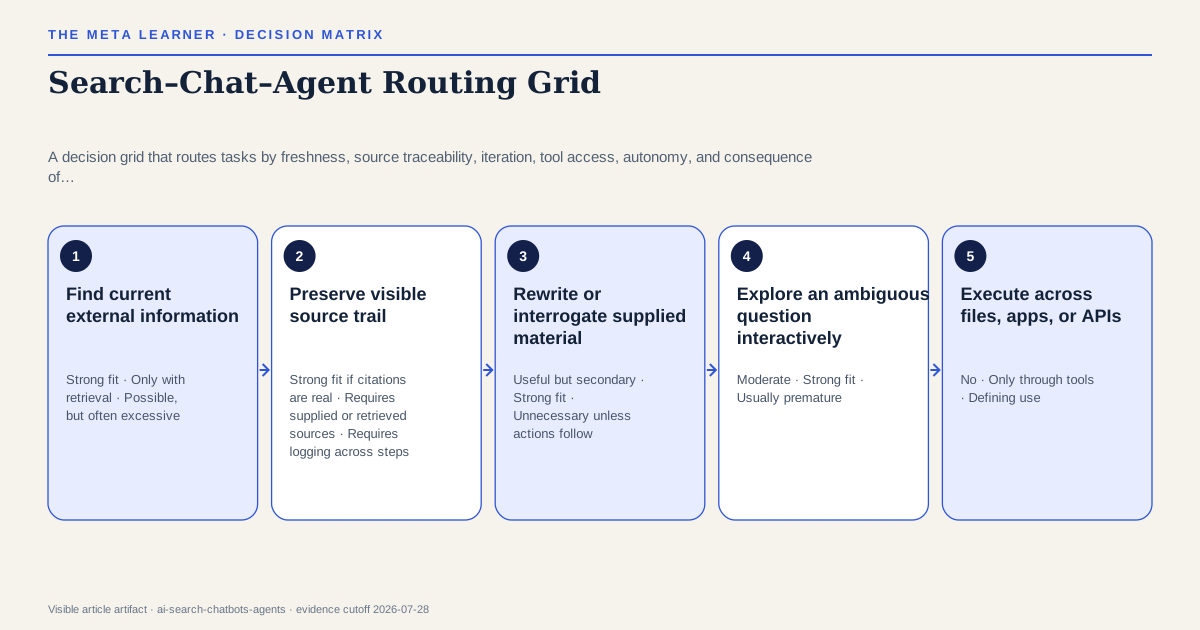
Use AI search when freshness and traceable sources are central; use a chatbot when the work is iterative transformation, explanation, or ideation over material you can inspect; use an agent only when the system must perform a sequence of actions through tools. When two options work, choose the one with less autonomy and fewer permissions.
Three labels hide three different jobs
“AI search,” “chatbot,” and “agent” are marketed as rival products, but they are better understood as system patterns. One retrieves evidence, one sustains a generative interaction, and one pursues a goal through actions. A single product may contain all three.
This comparison is for researchers, operators, and learners choosing a pattern for a concrete task. It is not a vendor leaderboard. Interfaces and names change; the underlying questions—where information comes from, what the system may do, and who checks the result—remain.
Retrieval-augmented generation was introduced as a way to combine a generative model with retrieved external memory for knowledge-intensive tasks. rag, agents, nist Agent designs add tools, control flow, and varying degrees of model-directed action. agents NIST's risk framework makes context, measurement, and management part of the system decision rather than an afterthought. nist
The routing grid
| Need | AI search | Chatbot | Agent | |---|---:|---:|---:| | Find current external information | Strong fit | Only with retrieval | Possible, but often excessive | | Preserve visible source trail | Strong fit if citations are real | Requires supplied or retrieved sources | Requires logging across steps | | Rewrite or interrogate supplied material | Useful but secondary | Strong fit | Unnecessary unless actions follow | | Explore an ambiguous question interactively | Moderate | Strong fit | Usually premature | | Execute across files, apps, or APIs | No | Only through tools | Defining use | | Keep consequences easy to reverse | High | High for draft-only work | Depends on permissions and checkpoints | | Minimize attack surface | Smaller | Moderate | Largest of the three |
The table describes tendencies, not guarantees. An “AI search” product can fabricate a citation; a chatbot may have excellent web tools; an “agent” may actually be a fixed workflow.
Evidence inside the case boundary: Search–Chat–Agent Routing Grid
Research supports retrieval as a distinct way to supply external knowledge to a generator, while practitioner architectures distinguish predefined workflows from systems that dynamically choose actions. NIST supports evaluating the complete socio-technical system. Evidence does not establish that agents are generally superior; fitness depends on the task, tools, controls, and evaluation.
rag, agents, nistSearch is a claim-finding instrument
Choose search when the first obligation is finding and opening evidence: recent policy, a primary paper, an official specification, or competing accounts of an event. Good search should expose URLs, dates, publishers, and passages so that the user can leave the generated summary and inspect the source.
Search fails when retrieval misses the decisive source, ranking rewards popularity over authority, or the synthesis says more than the pages support. The control is not “ask twice.” It is query diversity, primary-source preference, opened-source verification, and a record of what was not found.
Chat is an iterative workbench
Choose a chatbot when the value comes from dialogue: narrowing a question, rehearsing objections, transforming a supplied draft, generating alternatives, or receiving hints while learning. The user can change constraints and inspect each turn without granting external action.
Chat is weak when the answer depends on facts outside its available context. A smooth explanation is not evidence of current knowledge. Supply an approved source set, add search, or separate brainstorming from factual verification.
Agency is permission plus persistence
Choose an agent when a system must maintain state, choose steps, use tools, observe results, and continue: for example, triaging a bounded inbox, testing a code change, or collecting structured fields from approved documents.
That extra usefulness creates extra obligations:
- Tools need least-privilege access.
- Untrusted content must not silently become instruction.
- Intermediate state and actions need logs.
- Irreversible or external actions need checkpoints.
- The system needs a budget, stop condition, and failure destination.
An agent that drafts an email is different from one that sends it. The word “agent” does not specify that boundary; the permission design does.
Route a task before choosing a product
Write the task as an input–operation–output sentence: “From these approved policy pages, extract each retention rule into a table with a source passage.” Then score six questions:
- Does the task require information newer than the model's supplied context?
- Must every decision-relevant statement be traceable to a source?
- Is iterative conversation itself the main value?
- Must the system act in another tool?
- Can an action be reversed before anyone is affected?
- Who owns the final decision?
If only the first two are “yes,” begin with search. If the third dominates, use chat with supplied evidence. If the fourth is essential, design an agent—but add permissions and checkpoints proportional to the fifth and sixth.
The routing record must name a decision owner. Search results need a human reviewer who opens the decisive sources; chat output needs an accountable user who owns interpretation; agent actions need a human checkpoint before an external or irreversible effect. “A person can intervene” is not ownership unless that person receives the evidence, has authority to stop the run, and knows which failure conditions require intervention.
For a practical sequence, first define the operation with the generative-AI capability map, inspect the additional machinery in What Is an AI Agent?, and compare knowledge architectures in RAG vs Fine-Tuning vs Long Context when evidence retrieval is the core.
Selection errors that create avoidable risk
- Buying “agentic” software for a problem that needs better search.
- Using chat memory as if it were a source of record.
- Asking search to make a value judgment the team has not defined.
- Giving write access because read access feels inconvenient.
- Evaluating final prose while ignoring missed sources and hidden actions.
- Treating a provider's category label as a technical specification.
Where the categories blur
Modern products combine retrieval, conversation, code execution, memory, and tools, and vendors use “agent” inconsistently. This article therefore cannot classify a product from its name. Inspect current documentation, actual data flows, permissions, logs, and model behavior before use. The routing grid also does not address procurement, data residency, sector regulation, or accessibility requirements, all of which may override the functional choice.
The mature question is not “Which AI category is most advanced?” It is “What is the smallest system that can do this job with evidence and control?”
Named sources
Evidence and further reading
Published July 29, 2026. No substantive revision has been recorded. Evidence last verified July 28, 2026.