AI Prototyping for Non-Engineers: Where Speed Ends and Engineering Begins
Use AI to test an idea quickly while recognizing the exact boundaries where security, data, reliability, accessibility, and ownership require engineering.
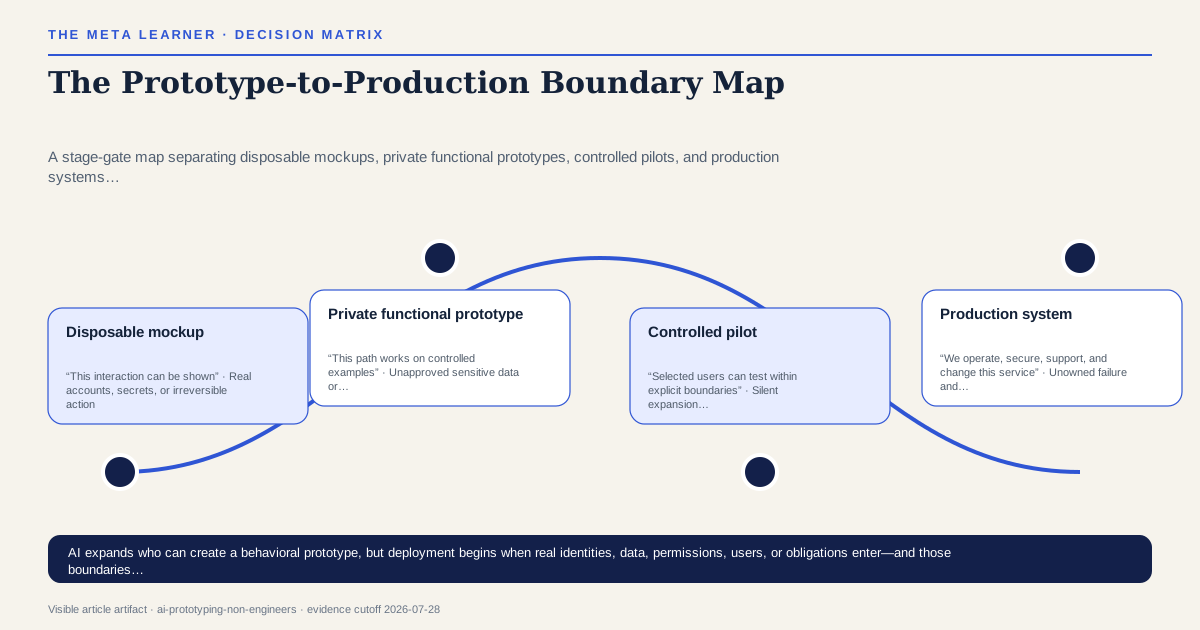
Non-engineers can use AI to create mockups, explore workflows, and test whether users value a behavior. Engineering begins when the prototype handles real data, identities, permissions, money, external actions, or dependable service. At that point, generated code needs architecture, security, testing, observability, accessibility, deployment, and maintenance ownership. The appropriate engineering controls depend on system architecture, jurisdiction, users, data, and consequence.
A working screen is evidence of possibility not readiness
AI coding tools can turn plain-language intent into a clickable application remarkably quickly. That changes the economics of learning and discovery. A domain expert can test an interaction before writing a specification for a team.
The danger is a category error: “It works on my laptop” becomes “it is safe for customers.” Secure software guidance treats development as a lifecycle of preparation, protection, production, and response. ssdf, nist, owasp, hai Application-security standards describe many verification needs that a visually successful demo does not reveal. owasp AI components add their own mapping, measurement, and governance obligations. nist
Four stages, four promises
| Stage | Legitimate promise | Keep out | |---|---|---| | Disposable mockup | “This interaction can be shown” | Real accounts, secrets, or irreversible action | | Private functional prototype | “This path works on controlled examples” | Unapproved sensitive data or public dependence | | Controlled pilot | “Selected users can test within explicit boundaries” | Silent expansion beyond monitored scope | | Production system | “We operate, secure, support, and change this service” | Unowned failure and maintenance |
A prototype can be valuable without pretending to be more mature. Labeling protects the experiment.
The boundary triggers
Engineering attention becomes non-optional when any trigger appears:
- authentication or authorization;
- personal, confidential, regulated, or licensed data;
- database writes and migrations;
- payments or resource spending;
- messages sent under a real identity;
- tool use against live systems;
- public users or accessibility obligations;
- uptime, recovery, support, or deletion commitments;
- decisions that materially affect people.
These are not advanced polish. They are the infrastructure of trust.
Why the evidence supports the Prototype-to-Production Boundary Map
NIST and OWASP guidance support lifecycle security, explicit risk management, and verification beyond functional behavior; independent human-AI interaction research adds requirements for understandable feedback, correction, and user control. The four-stage model is an editorial synthesis for scoping AI-assisted prototypes. No framework can certify a system without inspecting its actual architecture and use.
ssdf, nist, owasp, haiPreserve the domain expert's advantage
The non-engineer often understands the workflow better than the engineer: which exception matters, what users distrust, which evidence must be visible, and what “done” means. Use AI prototyping to make that knowledge concrete.
Create:
- a clickable path through the core job;
- representative and adversarial sample inputs;
- visible failure and uncertainty states;
- a decision log explaining scope;
- a list of assumptions that only real users can test.
Then hand engineering a sharper question. The goal is not to replace professional skill but to reduce ambiguity before expensive implementation.
The minimum handoff packet
Before a prototype crosses into pilot, document:
- Users and jobs in scope.
- Data classification and retention.
- System diagram and external dependencies.
- Permissions and identity model.
- Known failure modes and abuse cases.
- Test set, baseline, and blockers.
- Human approvals and support path.
- Deployment, monitoring, rollback, and deletion ownership.
Generated code without this packet is a pile of implementation decisions nobody has owned.
Run a four-gate prototype review
Gate one—value: Does a user complete a meaningful job better than with the baseline?
Gate two—truth: Does the behavior survive representative and difficult examples?
Gate three—exposure: What real data, identity, permission, or consequence enters?
Gate four—ownership: Who can secure, deploy, monitor, repair, and retire it?
Demonstrate failure before asking for trust
Prepare a representative test set before the pilot: ordinary inputs, boundary cases, malformed data, unauthorized requests, accessibility paths, dependency failure, and recovery. Preserve the baseline and every blocker. A demo that shows only the intended path is a sales artifact, not an evaluation.
Assign an accountable decision owner to each production promise. Engineering owns the technical controls it can verify; the domain owner defines unacceptable outcomes; security and privacy owners govern their boundaries; operations owns monitoring and recovery. Put a human checkpoint before real data or external effects until evidence supports a narrower automatic path. If the team cannot name who repairs an error on a bad day, it is not ready to make that behavior someone else’s dependency.
Record the handoff decision and rejected scope. Future maintainers need to know which attractive prototype behaviors were intentionally excluded, because an old demo can otherwise re-enter production as undocumented functionality.
Only advance when the next-stage owner accepts the new promise. Start with Build Your First Useful AI Workflow, threat-model model-facing content through Prompt Injection Explained, and build a local gate with AI Evals for Knowledge Work.
How prototypes accidentally become products
- Sharing a public link because the demo “contains no important data yet.”
- Adding authentication as a cosmetic screen without authorization rules.
- Copying secrets into generated code or client-side configuration.
- Letting test users enter production data without a retention policy.
- Measuring delight while ignoring wrong, inaccessible, or unsafe paths.
- Depending on a library or service no one will maintain.
- Calling beta status a substitute for incident response.
- Allowing the prototype's first architecture to become permanent by inertia.
The boundary depends on consequence
This article cannot determine whether a particular prototype is secure, lawful, accessible, or production-ready. A small internal tool can still be high-risk; a public toy can still collect harmful data. Generated and human-written code both require review. Consult qualified engineering, security, privacy, accessibility, and domain professionals whenever the actual use triggers their responsibilities.
AI has democratized the artifact of software. It has not democratized away the obligations of operating software for other people.
Named sources
Evidence and further reading
Published July 29, 2026. No substantive revision has been recorded. Evidence last verified July 28, 2026.